Set as favorite
Bookmark
Email This
Hits: 9327
Trackback(0)
Comments (30)

Abdul-Kareem
said:
|
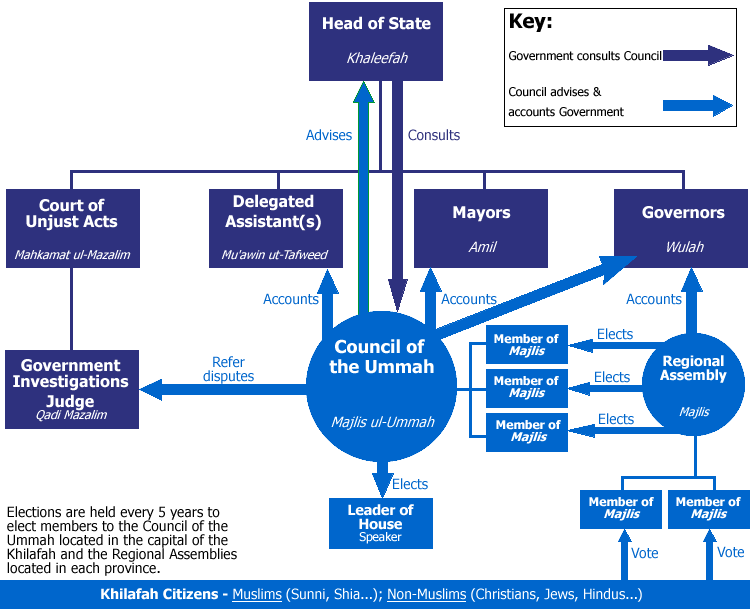
wa salam. All your questions are answered in detail in this book "Institutions of the Khilafah State" http://www.khilafah.com/images...jhizah.pdf I strongly advise reading the section on "Council of the Ummah" page 142. I have answered what I can below. The Majlis ul-Wiliyah (Regional Assembly) and Majlis ul-Ummah (Council of the Ummah) are not the same as a parliament although there may be superficial similiarities such as being a representative body. However, the majlis is not legislative. Democracy is not voting but ruling by the people with human beings legislating laws. Islam has allowed voting as a style in certain situations. It cannot be used in legislation since the process of extracting laws is through ijtihad. It can be used to elect the Caliph, members of the majlis and for some public affairs policy. There are multiple Majlis ul-Wiliyaat (Regional Assembly's) located in each province of the Caliphate, as the chart mentions. Yes, the public will vote for members of their Regional Assembly and this regional assembly will appoint some of these to the central Majlis ul-Ummah (Council of the Ummah). The Majlis is a body for representing and accounting the government. The primary role of majlis members is to account the government and represent the people in their district. They will also have voting rights on certain areas of public policy. Muslim members who are qualified in sharia will sit on the sharia committee to give their view on legislation and can also take part in the election of the Caliph. Non-Muslims cannot be on the sharia committee because belief in Islam is a condition for this. Non-Muslims in the Caliphate have a different societal contract with the government to Muslims. Muslims are bound by the bayah contract whereas non-Muslims are bound by the dhimma contract. The Caliph is elected via the bayah. Western democracies operate a bicameral system with two legislative houses - lower house and upper house. In Britain the lower house is the House of Commons and the upper house is the House of Lords which counterbalances the House of Commons. In Islam we only have one Majlis ul-Ummah but its powers are counterbalanced by a wing of the judiciary called the Court of Unjust Acts (Mahkamat Mazalim). This consists of supreme judges not elected individuals. As in any state the government has to adopt laws for society which must be obeyed. The Caliphate doesn't adopt in beliefs and personal worships so shias and those of any other school of thought can live fine. In terms of societal laws such as establishing companies, paying taxes, health service, transport etc everyone Muslim or non-Muslim will obey these. Shias can be appointed to government posts or be members of the majlis. In terms of being the Caliph I dont know what the theological position of shia is on this vis-a-vis their belief in wiliyat ul-faqih and the mahdi. |
|
|
report abuse
vote down
vote up
|
Neeqo
said:
|
assalamu alaikum, i am a keen reader of ur website and have chatted to many a person who wants to install a Caliphate system of governance each having wildly different versions of how a khilafah should be run. Your chart (http://www.khilafah.com/index....s-ul-ummah) seems to be EXACTLY the same as the British democratic voting system, the only difference being, that the different institutions have arabic names. The house of commons is the 'majlis' in ur diagram and the house of Lords is the majlis un ummah as only the majlis seem to be able to vote for the people who make up the majlis un ummah. According to ur chart the public seem to only vote for the majlis and the majlis vote for the majlis un ummah as the blue arrows point from the public towards the majlis sign and NOT towards the majlis un ummah. In writting u say that the public votes for the majlis un ummah, so which way is it? Also who exactly are the Majlis un ummah? How can they be qualified to give advice based on islamic scripture? Is it exactly the same as the iranian's assembly of experts? Also how would u have a khaleefah system with shias? Because shias dont believe in the authenticity of Sahih Bukhari or Muslim, so would that mean they as well as women and non muslims would be discounted as presidential candidates? How can this system be perfect when u have a barrier towards women and none muslim from gaining political power, this is putting a barrier on around 60% of ur population, surely this is wrong.... Plz reply to my questions, and PLEASE DONT FOB ME OFF WITH RANDOM LINKS TO WEBSITES. Give me proper concise answers. jazakallah khairan.. |
|
|
report abuse
vote down
vote up
|
Fahad
said:
|
@Turkish Babur- What are you going on about? I'll all for a united Khilafat. And the rest about Ottomans- I didn't say anything about Ottomons. I'm only saying that expansionist policy as stated by the moderator here, is not correct- and would lead to un-ending wars. |
|
|
report abuse
vote down
vote up
|
turkish babur
said:
|
I read the arguments. ************************* Jibrael, We muslims were the best nation, we were ahead in taqwa, science, military, tech. . . go read some history books. Here look even NON MUSLIMS historians have dubbed Islamic state as the most richest history of mankind!! "........Yet even a rapid sketch will show how much Islam did for Europe in the middle ages. Islam founded the great university of CORDOVA which attracted Christian scholars from different parts of Europe. One of these scholars became, in due course 'The Pope of Rome'. "--[ The Spirit and Struggle of Islam, by Prof. T.L.Vaswani, Ganesh & co., Madras-1921, pg-14] " At the time when Europe was in darkness. the muslim scholars of Spain held high the torch of science and literature. They taught medicine and mathematics, chemistry and natural history, philosophy and fine arts. "--[Ibid, pg-14] " Under the enlightened reign of the Abbasides, the Fatemites and the Ommiadss rulers, learning and culture prospered respectively in Asia, North Africa and Spain. From Samarkand and Bokhara to Fez and Cordova, numerous scholars studied and taught astronomy, methamatics, physics, chemistry, medicine and music."-- [The Historic Role of Islam, by M.N.Roy, pg-69,Vora & Co.8 Round Building, Bombay-2] In the opinion of HUMBOLDT,[Kosmos, Vol-II], the Arabians are to be considered, "the proper founders of the physical sciences,in the signification of the term which we are not accustomed to give it." Sir John Bagot Glubb “Khalif (Caliph) Al-Ma'mun's period of rule (813 - 833 C.E.) may be considered the 'golden age' of science and learning. He had always been devoted to books and to learned pursuits. His brilliant mind was interested in every form of intellectual activity. Not only poetry but also philosophy, theology, astronomy, medicine and law all occupied his time.” “By Mamun's time medical schools were extremely active in Baghdad. The first free public hospital was opened in Baghdad during the Caliphate of Haroon-ar-Rashid. As the system developed, physicians and surgeons were appointed who gave lectures to medical students and issued diplomas to those who were considered qualified to practice. The first hospital in Egypt was opened in 872 AD and thereafter public hospitals sprang up all over the empire from Spain and the Maghrib to Persia Robert Briffault in the "Making of Humanity" "It was under the influence of the arabs and Moorish revival of culture and not in the 15th century, that a real renaissance took place. Spain, not Italy, was the cradle of the rebirth of Europe. After steadily sinking lower and lower into barbarism, it had reached the darkest depths of ignorance and degradation when cities of the Saracenic world, Baghdad, Cairo, Cordova, and Toledo, were growing centers of civilization and intellectual activity. It was there that the new life arose which was to grow into new phase of human evolution. From the time when the influence of their culture made itself felt, began the stirring of new life. "It is highly probable that but for the Arabs, modern European civilization would never have arisen at all; it is absolutely certain that but for them, it would not have assumed that character which has enabled it to transcend all previous phases of evolution." Fahad, I would like to tell you that ottomans were band of one of true muslims who followed pure islam. Anyone who came in their way they fought with them whether muslims or kuffars. They wanted to unite whole of muslims under one leader. Before them muslim caliphate became divided (although ahkam shariat was applied on the lands) after few hundred years of death of Ali (ra) when shiite fatimads seek kuffar byzantium help to destroy sunni leadership. Turks crushed Fatimads and Byzantium in Manzekert battle hence restoring the dominion of calphate over muslims as well as byzantium. Ottomans didnt want the muslims to suffer like in crusades, so they wanted to unite the muslims under single leader. So some muslim regions were fought after they assumed title of caliph in 1524. And you are totally wrong to say that ottomans didnt care for indian muslims or persians. Or indian muslims never gave bayah to ottomans. perhaps u shud read about khilafat movement in india after WWI. And also to add to ur knowledge that when delhi sultanate under lodhi dynasty who were misaplying sharia and allowing hindu kuffars to dominate over muslims, declining, Ottomans supplied their troops to the ruler of samarkand - BABUR. He reconquered India and recognised the ottomans as caliph. All mogul rulers recognised ottoman caliph except akber who apostised from islam. Now of course u wud defend akber. Lastly when british came to loot indian subcontinent, ottomans armed tipu sultan with their armies and technology. Hence vanquishing british in 3 battles. |
|
|
report abuse
vote down
vote up
|
Abdul-Kareem
said:
|
This article should answer the questions on elections and appointing the Khaleefah. http://www.khilafah.com/index.php/the-khilafah/issues/1752-the-method-to-appoint-a-khaleefah |
|
|
report abuse
vote down
vote up
|
MUHAMMAD UMER FAROOQ
said:
|
Assalam o alaikum, respected org staff, you have mentioned that ''elections are held every 5 years to elect members to the council of ummah.... and the regional assembles....'' first of all i want to questioned you that in ISLAM and epically in KHILAFAT is there any EXAMPLE,SIGN,ADVISE of elections to held for choosing the KHALIFA or people who are the advisors and consultants for running a MUSLIM STATE (PEOPLE OF MAJLIS E SHUURA) from QURAN, SUNNAH, AND THE PERIOD OF 4 KHALIFA'S OF ISLAM?........AND WHILE CONDITION OF ELECTIONS IS THAT ELECTIONS ARE TAKING HELD BETWEEN ALL PEOPLES IN WHICH PEOPLE NON SUPPORTERS AND AS YOU MENTIONED''NON MUSLIMS Christians Jews Hindus....'''ALL ARE PRESENT.......SO don't you think that non supporters and non Muslims can easily take approach to the upper class of administrators and runners of state just like the present situation of nearly all the MUSLIM COUNTRIES epically PAKISTAN..........AND THIS TYPE OF ELECTIONS ARE DIRECT PART OF '''DEMOCRACY''' ABOUT '''WHOM''' IQBAL SAID THAT 'DEMOCRACY IS THE WAY OF GOVERNING IN WHICH PEOPLES ARE COUNTED NOT WEIGHTED(to check who is more powerful on the basis of TAQWA and SUNNAH)'hence this is my question.....waiting for answer as it suspects.....with a lot of prayers to KHILAFAT MOVEMENT.......... your brother M UMER FAROOQ |
|
|
report abuse
vote down
vote up
|
Abdul-Kareem
said:
|
RE: Humayan By reading your views and discussions with other participants it seems that you have taken a very biased and one dimensional interpretation of Quran and Hadith. Our Creator Allah (swt) is the one who defines what is good and bad not our whims and desires. If a sharia rule based on Islamic texts shows an action to be good then regardless of what human beings think from their biases it is good (khair). Terms such as dictatorial, totalitarian, oppressive etc should not enter the discussion when we are discussing sharia rules. It is forbidden to force non-Muslims to convert to Islam but they are forced to live under the system of Islam as dhimmi. Living under the Islamic system is the best dawah for them as they witness for themselves how Muslims conduct themselves in economic, politics, judiciary etc . This is not oppressive and you should not be ashamed of the Islamic conquests that took place simply to make Islam sound pleasing to the ears of non-Muslims. We have a distinctive way of life that can be proved to be from the Creator Allah (swt). Once this belief is in place and someone submits to the will of Allah (swt) ie becomes Muslim then they accept whatever the sharia determines as good or bad regardless of their inate biases. Any arguments you want to be bring must be based on the sharia texts. I end with one example from the classical book ‘Kitab Al-Kharaj' by Abu Yusuf which shows Islam's foreign policy and rule over non-Muslims in action. After getting on peaceful terms with the people of Syria and collecting the dues of the Jizya and the Kharaj , news reached Abu ‘Ubeida that the Byzantines had amassed their troops to attack him. The effect of this was great on Abu ‘Ubeida and the Muslims. He sent messages to the rulers of cities with whose citizens he had made peace, asking them to return to their subjects the paid dues of the Jizya and Kharaj with an instruction to tell them: ‘We hereby return to you the money you have paid us, because of the news of the enemy troops amassed to attack us, but, if God grants us victory against the enemy, we will keep up to the promise and covenant between us.' When this was delivered to the dhimmi and their money returned to them, they told the Muslims: ‘May God bring you back to us and grant you victory over them! |
|
|
report abuse
vote down
vote up
|
Humayun
said:
|
Dear Brother Abdul-Kareem! By reading your views and discussions with other participants it seems that you have taken a very biased and one dimensional interpretation of Quran and Hadith. Your views represent a totalitarion and dictorial form of khilafah, which itself counters the basic purpose of khilafah or a united, single and central muslim government. The main purpose of khilafah form of goverment is to have central muslim government under which the muslim ummah can live their lives in accordance with the principals of islam resulting in Rule of Allah(SWT) law, peace, harmony and social justice. Your views on Khilafah which is expansionist and dictorial are totally against the basic purpose of Islam. According to Islam we cannot and we must not force any nation or an individual to accept Islam. To accept Islam is by choice not by oppression. Thats why we cannot attack a nation or a country for spreading Islam, as this will clearly mean spreading of Islam by sword. And the sad thing is you are trying to support your views by taking the teaching of Quran, Hadith and events of Muslim hisotry out of context. And the only picture that emerges from your views is that you are trying to setup a Khilafah system which is dictorial and expansionist. There is no doubt about it that Muslims today need to be united under the banner of Islam, so as to create a single nation which is bound by the rules of Allah(SWT) given to us in the form of Quran and Hadith and establishment of a united, single government which ensures implementation of these laws. All this is to ensure the strenght of the Muslim Ummah against oppression, Rule of Allah (SWT) law (Shariah), peace, harmony, social justice. And our duty is to only establish this system and make it a model for the rest of the world to see and follow suit. Not to become an expansionist nation which is bent on forcefully implementing its beliefs on people who either dont want this system or not ready for this system. This brother is not Islam this is dictatorship. Therefore brother, dont project this sytem as an oppressive system from the onset by giving your views based upon out of context interpretations of religious scriptures and Islamic history. Let us build the foundation of our future United and single muslim goverment on true meaning of Islam, that is peace and justice for all. |
|
|
report abuse
vote down
vote up
|
Abdul-Kareem
said:
|
RE: Fahad I believe the verses and commandments of Allah and his Prophet have a REASON behind them. If you don't want to understand the reason but only look at the verse then you end up with the wrong interpretation. As I mentioned previously only qualified scholars who understand the Qur'anic principles laid down in usul-al-fiqh can interpret the Qur'an and derive shariah evidences from it. It is wrong for us to decide if a verse of Qur'an has a reason ('illa) behind it or not. There is a whole methodology for interpreting verses of Qur'an and determining if a verse has a shariah illah (reason) in it or not. Sometimes Allah told us the reason and othertime He did not according to His infinite wisdom. As Muslims we hear and we obey. I strongly advise you to research more into the topics of ijtihad, illa, ulum ul-Qur'an etc before deriving conclusions which do not conform to any shariah methodology. There are some nice articles on this website that may interest you. Here is one specifically on Reason (illa) http://islamicsystem.blogspot....n-and.html |
|
|
report abuse
vote down
vote up
|
Fahad
said:
|
I think you are taking things too much out of context. I'm not contesting the "generality" of the verses. I believe the verses and commandments of Allah and his Prophet have a REASON behind them. If you don't want to understand the reason but only look at the verse then you end up with the wrong interpretation. For example the your generality when the Quran says "Kill them wherever you find them" will mean that I should go around killing all the non-muslim. BUT when understand the REASON for this verse we understand that it refers to those on battle. Similarly the verse you quoted you have to understand the REASON behind it! The Prophet (sallalahu alayhi wasalaam) and thus Islamic Law made the punishment of theft to be the cutting of the hands! Who gave Hadrat Omar the right or authority to overthrow a law that was made by the Prophet? At the time of a epidemic he nullified this. WHY? Because he understood the REASON behind the law. Islamic Law "changes" as required by the the conditions. And what I mean by change is not completely off Shariah, but rather the rules are relaxed a little until the ideal society is created when the stricter rules then apply again! We need to understand that the Quran has a history and REASON. The principal of generality is that if a "similar" events take shape then we are applying the verses to fight. Allah says "Oppression is worst than Slaughter" why did then the Prophet make treaties with the Opressors for clearly they did not follow the law as laid down by Allah! Did not so many of the Caliphs make treaties with other Empires! Did they not read the Quran that these people are Oppressors! Why did they not fight these oppressors? Were all of them including the Prophet at fault? (Astagfarullah!) Surely they read it and they understood it! But their understanding is clearly different than yours. Allah Knows Best Asalaam-O-Alaikum Warahmatullahi Wabarakatahu |
|
|
report abuse
vote down
vote up
|
Abdul-Kareem
said:
|
RE: Fahad Allah is the one who defines what is good and bad, and assigns us our rights. The Shariah is the basis for all our actions interpretated by qualified scholars according to a detailed set of legal principles. Our right to rule a land is not due to nationalistic or historical reasons but it is for Islamic reasons, i.e. every land in the world must be ruled according to Allah's law. As for the verse of Qur'an. The Qur'an is in Arabic not english. The scholars laid down an entire science ilm ul-Qur'an for interpretation of Qur'an. When it comes to Quranic verses what matters is the generality of the wording and not the specificity of the cause (Al-'ibra bi 'umum al-lafz laa bi khususiyyat al-sabab). The manat (reality) of this last clause of the verse is hukm (ruling/judging). They are referred to as dhalimoon (oppressors). Wrongdoers is fasiqoon in Arabic and there is another verse which mentions those who do not rule by whatever Allah has revealed are fasiqoon, but not this verse. |
|
|
report abuse
vote down
vote up
|
Fahad
said:
|
Okay by that definition Muslims didn't rule from the beginning, if we have the right to take back the land because we once ruled it, then Britian has the right to fight and take back all lands that were theirs? Maybe another Mongol army comes and then they claim their right to basically all of the Islamic Empire so on and so forth. The fact that we DID rule these lands should only be taken as history otherwise we will just be having un-ending wars because there are others who ruled those lands before Muslims too. And the verse you quoted, care to read the context? It is clearly for those who have the Law, and it saying that if you don't follow the "eye for eye..." as is instructed then you are a wrong-doer. It is clearly for People of the Book and Muslims and it refers to not following the law which in-itself is the breaking of the law as thus the word "wrong-doers" is used. As for a nation that doesn't even consider their state religious this isn't even applicable. or an excuse to fight them. |
|
|
report abuse
vote down
vote up
|
Abdul-Kareem
said:
|
RE: Fahad Offensive Jihad has different rules to defensive jihad where a country has occupied Muslim land. Its not allowed to open up a new land without going through three stages as mentioned in the hadith I quoted below and mentioned in the Fiqh books. 1. Invite them to Islam 2. Ask them to live under the rule of Islam and pay jizya 3. Fight to remove those obstacles standing in the way of implementing Islam upon the people. I agree with your points about the treaties. These all form part of the first two stages and a future Khilafah will make treaties with kuffar nations to open up them to the dawah. However, as happened in the past which you refer to as "defensive offensive" there is a need for an army as a last resort to remove an oppressive regime that has broken its treaty with us. There is one more point that is important to make regarding your issue of "hypocrisy". Why must Israel give up the land they occupied which they rightly conquered after Muslim lost the war? You're talking plain hypocrisy. There is no reason for them to give it back because they conquered it in battle just like Muslims, but there is reason for Muslims to take it back because the Israelis are oppressing the Palestinians. Simply put in todays world Occupation = Oppression whether it be Israeli's doing it or Muslims. Our likes, dislikes and definition of terms must be in line with the shariah. Any land not ruled by Islam is oppressed since Allah (swt) said: وَمَن لَّمْ يَحْكُم بِمَا أنزَلَ اللّهُ فَأُوْلَـئِكَ هُمُ الظَّالِمُونَ "and whoever did not rule by what Allah revealed, those are the oppressors (dhaalimoon)." [Al-Maida, 45] Regardless of Israel's conduct to the Muslims it has occupied Muslim land and we look to what Islam says about people who occupy Muslim land which is defensive jihad to expel the enemy. This is not hypocrisy but following the Islamic rulings on issues. There is an article which compares western occupation to the Islamic conquests which you may find of interest: http://www.khilafah.com/index.php/the-khilafah/foreign-policy/2353-western-occupation-vs-islamic-conquests-a-tale-of-two-states |
|
|
report abuse
vote down
vote up
|
Fahad
said:
|
I forgot to talk about the 2nd hadith you mentioned. As it clearly says when you "meet your enemies", clearly any land that you have a treat with or has not "fought you" or tries to fight you as instructed in the Quran is NOT an enemy! So this in no way supports an expansionist policy, this is again in defensive expansion and even this is only applicable in the age that like I said either you expanded or were expanded upon. Why must Israel give up the land they occupied which they rightly conquered after Muslim lost the war? You're talking plain hypocrisy. There is no reason for them to give it back because they conquered it in battle just like Muslims, but there is reason for Muslims to take it back because the Israelis are oppressing the Palestinians. Simply put in todays world Occupation = Oppression whether it be Israeli's doing it or Muslims. |
|
|
report abuse
vote down
vote up
|
Fahad
said:
|
It is true that the Muslims can fight when there is oppression in other lands, but ruling over people who do not want such rulers is oppression in itself. If the people of other countries like democracy then you can not go and destroy their system because then you become the oppressor. If the Khilafah really works others will try to implement it because they see it working. Remember the Prophet was invited to Madina because they believed that his character and the fact he was an ansar will work for their society. Prophet didn't forcefully take Madina. Also Mecca was not an offensive war like I said there was a broken treaty. Treaties with Kuffar nations are allowed, so when the Quran says fight them there are conditions. First condition is "fight those who fight you!" That was the first revealed order when the order to fight was given. You can't ignore the history of the verses. The hadiths you have quoted and used as support are totally out of historical context. If Prophet Muhammad was truly ordered to "fight" everyone until they accept the Kalima there was no reason to allow the different religious groups to live under him or to make treaties with other Kuffar nations. He could simply fight them all and Allah would have protected him. Clearly these hadiths are talking about the fact that the Prophet Muhammad was talking about "fighting" in the sense that he fought them when they ridiculed him he "fought" their kuffar beliefs until they believed but never did he use force to convert anyone. Prophet Muhammad pbuh never liked wars, and always tried to make treaties and that is what the Khilafah when established Inshallah must do, not expand but make way for a peaceful world and restore the dignity of Muslims. Regardless of the reason for Kuffar nations expanding, occupation is still occupation. And if people do not like such a rule then that is oppression in itself. |
|
|
report abuse
vote down
vote up
|
Abdul-Kareem
said:
|
RE: Fahad JazakAllah khair for your questions. The Prophet صلى الله عليه وسلم did not come just for the Arabs but he صلى الله عليه وسلم came for all of mankind. Islam is a universal message that must be propogated to the world. When the scholars speak about jihad they classify it into defensive and offensive jihad because there are different rulings and conditions for both types. When we say offensive it doesnt mean Muslims are like the hordes of Mongols who came out of Central Asia casuing destruction wherever they went. The aim of offensive jihad is not to kill people but to remove the physical obstacles (corrupt governments) that are preventing people from seeing and living the beauty of Islam. Unlike the western nations we believe in regime change for the sake of spreading Islam whereas the west perform regime change for their material colonial objectives. They dont care about the people they occupy as their objective is to steal the resources of the land. Iraq and Afghanistan are the primary examples here. Historically, Muslims conquered many poor lands in Africa and raised their standard of living because the objective was not how many diamonds or gold they had but that the people were living in darkness and need to live in the light i.e. worshipping Allah. The foreign policy of the Islamic State is defined in the Qur'an and Sunnah. Allah says: "Fight them until there is no more tumult or oppression and there prevails justice and faith in Allah, altogether and everywhere" [TMQ Al-Anfal: 39]. The Messenger of Allah صلى الله عليه وسلم said, "I have been ordered to fight (uqatila) the people (i.e. 'an-naas', all humankind) until they bear witness (embrace) that there is no god but Allah and Muhammad is His messenger. Until they establish the prayer and pay the Zakat and if they do so then their lives and their properties will be safe from me, except as the Shar’i would dictate (if it was breached) and their reckoning will be with Allah" [Bukhari and Muslim]. "When the Messenger of Allah صلى الله عليه وسلمappointed an ameer over an army or expedition, he would exhort him to fear Allah in his soul and to begood to those Muslims with him. Then he would say, 'Fight in the name of Allah, in the way of Allah. Fight those who disbelieve in Allah. Fight but do not betray, commit treachery, mutilate, nor kill a child. When you meet your enemy among the mushrikeen then call them to three such that whichever of them they respond to, accept it from them and do not fight them. Call them to Islam. If they respond to you accept it from them and do not fight them. Then call them to move (tahawwal) from their land to the land of the muhajireen and inform them that if they do this then for them are what is due to the muhajireen and against them is what is against the m u h a j i re en. If they refuse to move from it, then tell them they are like the bedouin Muslims upon whom does not run what rule of Allah which runs over the believers and there is no booty or spoils for them unless they fight Jihad with the Muslims. If they refuse, ask them the Jizyah, if they respond to you, accept it from them and do not fight them. If they refuse, seek help from Allah against them and fight them'" And finally many Muslims converted because of the Prophets' character not because they lived under the Khilafah. Also it was the message of Islam that is beautiful. Remember that when the Prophet صلى الله عليه وسلم made hijra to Medinah there were very few Muslims who came with him from Mecca even after 13 years of dawah. Yet when the Prophet صلى الله عليه وسلم made Hajj after 10 years living in Medinah there were tens of thousands of Muslims. This is the power of a state whose sole objective is the spread of Islam. I agree the sole reason someone becomes Muslim is due to the beauty of Islam. By living under a state implementing Islam there is no better method for people witnessing the justice of Islam. I highly recommend reading the following book for a more indepth answer to this question. "JIHAD AND THE FOREIGN POLICY OF THE ISLAMIC STATE" http://www.khilafah.com/images.../Jihad.pdf |
|
|
report abuse
vote down
vote up
|
Fahad
said:
|
I've read your discussion here with Jibreil and one thing astounded me, you said that the Khilafah is an expansionist state? Please give the proof, you mentioned few battles but please give me the sources that proof that they were offensive and not due to some broken treaty or something similar. The rest of the wars against the Persian and Romans, it is known that few battles happened when the Romans and Persians became scared of the Muslims, and since vast majority of the land was basically under these 2 empires, any attack they did allowed the Muslim nation to expand and take over these empires. This was considered 'defensive' at the time as either you expanded or were expanded upon! Since the Romans attacks occurred Muslims could attack any Roman area which included Jerusalem and Spain. They never claim to any treaty, and if any were made most were broken so they could keep expanding. A broken treaty allows Muslims to expand but it is defensive because at that time if you didn't expand you got expanded upon! If there was any offensive war then that is Unislamic. Just like you said that some Caliphs abused their power, similarly if they went in offensive wars it is unislamic! The fact is this: Your claims are that the Kuffar nations must leave the Muslim lands, but then you say that you have the right to expand into their lands. That is utter hypocrisy. This is nowhere close to "deal justly" with them as the Quran instructs. I believe in the Khilafah but what you are saying about expansion is utter nonsense that will lead the world backwards not forward. And finally many Muslims converted because of the Prophets' character not because they lived under the Khilafah. Also it was the message of Islam that is beautiful. |
|
|
report abuse
vote down
vote up
|
Abdul-Kareem
said:
|
RE: Salman The Council of the Ummah (Majlis ul-Ummah) has no legislative powers unlike in democracy where the parliament votes for laws. The Majls ul-Ummah is primarily a body to keep the government in check and on certain areas of policy its resolutions are binding on the Khaleefah. Laws in Islam are not determined by the majority of votes. Rather laws are dervied from Qur'an and Sunnah. If you are interested an indepth explanation of the Council and its powers and functions then see the chapter in this book "The Ruling System in Islam." http://www.khilafah.com/images...System.pdf |
|
|
report abuse
vote down
vote up
|
salman
said:
|
the problem arises here.......what is the differences between the democratic structure and the khilafah structure it looks the same i dont believe in democracy .....i believe in khilafah but i cant understand the real difference |
|
|
report abuse
vote down
vote up
|
Jibreil
said:
|
Thank you for your response. I still have grave doubts on the khilafah. You may think it is sound, but it is not. You say that the problem is human nature. Well, obviously. A dictatorship under the Prophet is better than the best system under evil tyrranical monsters. The point of a good system is so that it works when fallible humans take power. So, using that argument is invalid. May God guide us all. But I disagree strongly with the muslim history portrayed here. They weren't glorious days at all - they were filled with tyranny and monarchy - repugnant to the social spirit of Islam. Just look at the stories written in the historical books. Even Uthman, written under the title "Khalifa Rashid" - or "Rightly-Guided Caliph" - opted to place his own relatives in power and when Abu Dharr and Muhammad ibn Abu Bakr and other similar people (especially the Egyptians) came to Medina to complain of these relatives (eg. Marwan al-Hakam) they were exiled or ignored. This is injustice, and committed by the great rightly-guided Caliph! Or for example when Muawiyah, the companion of the Prophet, who fought against the Khalifa of his time, Ali, another companion of the prophet - how can we talk about a bay'ah in this? Or for the Ottoman Empire who didn't have the bay'ah of the Egyptians until they were conquered by force, and did not have the bay'ah of the Persian and Indian muslims, as well as those in the Far East! The great days of Islam to be proud of are the days of Muhammad (pbuh) and his companions when they lived in the small oasis of Medina, when Islam meant equaliy, fraternity and liberty - way before the Great French Revolution! Where there were no riches or palaces or large armies - but a band of outlawed slaves of God who lived to serve His Holiness! There was no Avicenna there! There was no Farabi or Kharezmi there! There was no Harun al-Rashid or Ma'mun al-Rashid to call for the greatest scientists in their huge castles! There was no scholar, no books of great learning, yet there was faith. That is what Islam prides itself for - not the empires that spanned three continents, but the small community that practiced the faith of Ibrahim (as) in an unheard-of oasis in the Arabian peninsula! You may disagree - and disagreement is allowed, alhamdulillah, but what we need first is not a caliphate - but a change of mentality: we were not the best community in these 1300 years - we were only the best ummah in Medina, with the Prophet, when all the companions were united. Just look at the history books - when the Prophet died, conflict was born between the companions, whether about the khilafah or about the laws of Allah (swt). The civil wars are evidence for this. Denying this is to live in the fanciful fantasy that everything was perfect. No, it wasn't. Only with faith and unity can we achieve what we were meant to be: the best Ummah. The neo-caliphate may succeed, but the ummah must understand: our ummah failed to live up to Islam not since Kemal Ataturk - nor since colonialism - not since the crusades - nor since the Umayyad usurpation of power - but since the Prophet's death, when the faith of some wavered, and envy and greed caused disunity between the companions and the ummah ... that is when we failed ... we failed to live up to the simple old days of Muhammad's Medina - may Allah (swt) bless him, his descendents and his noble companions. Islam has no offensive wars, for Allah (swt) has stated in the Qur'an that He dislikes the initiator of wars. And why did the caliphate attack Persia and the Byzantines but to spread Islam - by the sword - by force? Yet this is unIslamic. Only when we realise this - when we understand that the Prophet preached peace, and his wars were in last resort against the enemies and against fitna. May Allah (swt) guide us all - Alhamdulillahi rabb-ul-aalameen. |
|
|
report abuse
vote down
vote up
|
Abdul-Kareem
said:
|
RE: Jibreil JazakAllah khair for your comments. I appreciate your efforts in attempting to formulate a model for Muslim unity. However, we need to always keep in mind that our actions must be derived from the Islamic legal sources - Qur'an, Sunnah, Ijma as-sahaha and Qiyas (agreed upon sources among the scholars). Disagreements are fine but when we disagree on whether actions are good or bad again it is on the basis of the Islamic texts. This is the method of the scholars throughout history. The Khilafah model that this site has presented is based upon the ijtihad of Sheikh Taqiudeen an-Nabhani in his book Nizam ul-Hukm fil-Islam http://www.khilafah.com/images...System.pdf This book further elaborates on some of the earlier works by scholars on the Islamic systems such as Mawardi's famous Ahkam as-Sultaniyah. With 1300 years of hindsight the mistakes made in the previous Khilafaat can be learnt from. This is why we make the majlis ul-Ummah a pillar of the ruling system and bind the Caliph to the decision of this majlis on certain issues through the bayah contract. This is something that didnt exist previously and as you have pointed out led to rebellions and oppressive Caliphs from time to time. Also we empower the judiciary with the Court of Unjust Acts (Mahkamat Mazalim) which did exist for a period of time in the Abbasid Khilafah and was known as the Dar al-Adl (House of Justice). This court is a supreme court with the power to investigate the Caliph and any other government officials and corruption. Unlike ordinary judges they are investigating judges with the power to initiate cases themselves. This is another counterbalance to the exectuive power of the Caliph. Regarding some of the specific points you have raised. 1. The Bayah contract and all the issues surrounding it is derived from the Qur'an, Sunnah and the consensus (ijma) of sahaba. Each of the bayah's of the Khulufaa rashida were studied and in terms of styles they were all appointed differently. However, what the scholars derived from studying these processes in detail was that in each case the consent of the general public was achieved and this is the important point in any valid bayah. What Abu Bakr did in nominating Umar was because the people asked him to chose a successor. So Abu Bakr consulted with the general public for some time and realised that the majority were in favour of Umar so he nominated Umar. This was in no way totalitarian or dictatorial. Abu Bakr and umar were the greatest of the sahaba. You cannot say they didnt have an Islamic bayah. They implemented Islam 100% and their actions were agreed upon by the rest of the sahaba which makes this is an ijma which is a source of shariah. Unfortunately later Khulufaa misused this and the bayah was misapplied, although the bayah contract from a legal perspective was always there because the ummah on the whole gave bayah of obedience to all the Khulufaa except Yazid who was fought against by Imam Hussein (ra). The people gave bayah of obedience even though they had no say in the bayah of contract. 2. Regarding election of the Caliph. The Majlis ul-Ummah consists of elected representatives from throughout the Khilafah. They will vote on the candidates and shortlist down to two. Ideally a general election would be held to vote on the final two candidates. However if this isnt possible the majlis will decide on the final candidate also. The Mahkamat mazalim will decide if someone is ineligible to stand due to him not fulfilling the 7 contractual conditions. The weakness in any system is human beings. Historically when the ummah stopped accounting the Caliphs and some of the Caliphs committed oppression this lead to great problems and an eventual destruction of the state. The biggest guarantee of corruption by human beings is Taqwa. Its possible the Mazalim court could exclude a candidate for a particular reason but the final election is by the majlis. 3. In terms of foreign policy the Khilafah is an expansionist state and the fact that the prophet صلى الله عليه وسلم established a state in Medina and when he died the entire Arabian peninsula was under Islam with armies being dispatched to fight the Romans is evidence enough that many of the battles were offensive - Mutah, Tabuk, Conquest of Makkah etc. Under the Khulufaa rashida armies were sent out against the Persions and the Romans which eventually destroyed them and replaced their darkness with the light of Islam. This continued throughout Islamic history and we are eternally grateful for their sacrifice that brought Islam to our ancestors and protected us from eternity in hell. Although the Khilafah spreads to new lands this is in terms of the system and not forcing people to accept Islam because there is no compulsion in relgion. The best way for people to see the beauty of Islam is to live under its system and witness the justice that could only have come from the creator. Actions speak louder than words. |
|
|
report abuse
vote down
vote up
|
Jibreil
said:
|
The Islamic Union, in contrast to the Neo-Caliphate, is more practical. It is more economically stable. It is more multicultural. I agree, it would be more beuracratic, but it would be less absolutist. The Islamic Union is a Union of peoples under one banner - the banner of Islam. It respects the codes and local laws, the cultural and sectarial diversities, it allows these different practices, but also makes sure that the Shari'ah is implemented to its full alongside these local/national customs, and brings the countries together. The Islamic Union is the missing link between Nationalism and Ummah (Community). The Islamic Union will allow this transition, this evolution. A dive into this Neo-Caliphate will produce more confusion and corruption than a gradual but sure process that the Islamic Union provides. The Neo-Caliphate is rigid and inexperienced, difficult to change once it is in place. The Islamic Union is flexible and easy to deal with. The Neo-Caliphate has to break all those national barriers in one huge sweep - almost impossible. Forget how many people want this caliphate - that is unimportant. Think about the number of people who will actually actively work to bring about this state. Think about the revolutions necessary to topple the puppet regimes. The Islamic Union however will allow this transition in a smoother and less bloody way. It will respect the differences of culture and language. None of this "Only Arabic" nonsense. Arabic is the lingua franca, for sure - but the Islamic Union will respect all languages in its domains: Arabic, Turkish, Persian, Afrikaans, Urdu, Hindi, Albanian, Azeri, etc. The Islamic Union allows Sunnis to have their own laws and Shia to have their own legal system. The legislation of the Shari'ah will be generally applicable, but where there are interpretations, this is allowed. This would be difficult to achieve in a Neo-Caliphate. You keep reminding me that all these questions ahve somehow miraculously been answered in this link or that. I have skimmed through these E-books and I assure you, I am in this field of Islamic Politics long enough to know that they simply miss the issues. Again, I claim that all these are constructive criticisms. I know that this website will continue running promoting its ideas. But when the time comes to put these into action, I will pray that Allah (swt) does not do to this neo-caliphate what He did to the older institution. I ask you, brothers and sisters, if this same Caliphate failed before, was misapplied before, was torn by the secularists before, was corrupted before ... what guarantee is there that this will not happen again? This is not to be answered by hadith - This is to be pondered about. Just so you know, "a muslim does not get bitten from the same hole twice." - Prophet Muhammad (pbuh) |
|
|
report abuse
vote down
vote up
|
Jibreil
said:
|
A monarchy is where the King is soverign and legislates. In the Khilafah the legislative branch of government is sharia and the Caliph is bound by it. If you read history - and forgive me for saying you seem to have read little, or through biased spectacles - you will find that the Umayyad, Abbasid and Ottoman caliphs all legislated and sometimes outside the Shari'ah. There are some records that some so-called caliphs even consumed alcohol - but I will not enter that. However, there is a reason why 4 caliphs only were called "Rashidun" and not the rest. Maybe because some of these caliphs were not as "rightly-guided". The wars that the Khilafah fought externally was to spread Islam which was an obligation. Are you implying here that Islam was 'spread by the sword'? Please understand that I do not think the caliphs were all immune from mistakes, and I do not believe that Umar ibn Khattab's offensive (if it was just for spreading the word) was justified. Are you saying that the minute the Caliphate you propose is intact and strong, it ought to do attack and subdue the Non-muslim world by force? The Prophet's wars were defensive. What is an obligation is spreading the word by "means of good words and conduct" - what is a sin is to "compel others in religion". Also, who controls the elections? Who makes sure that the candidate for Khilafah is a muslim and just? Please see the “Accountability in the Khilafah” book link I mentioned earlier for details on this. The Mahkamat mazalim (Court of Unjust Actions) performs this role not an executive body. I actually did read that link before you posted it. I again repeat what I said: "What is to stop this particular political body to only allow its own desired candidates to run for the elections?" There are flaws with this. I repeat there are major flaws. The ruling system in Islam is the Khilafah and not an “Islamic Union”. We must be careful to always base our political understanding on the Islamic texts. Who is to say someone's interpretation is better than someone else's on the same text - you might say the Ulama have said x. But I tell you now, many Ulama have said y too. So, a choice between x and y, the Neo-Caliphate and the Islamic Union, I opt for the latter. This is the 2nd part of my comment. |
|
|
report abuse
vote down
vote up
|
Jibreil
said:
|
Well, I am very grateful to you for actually responding to my comments. This is a good first step in muslim relations where we are able to hear criticism. I am glad. I am afraid we are under the illusion that bay'ah simply means "the vote of some people who claim to represent the ummah" or "the vote to the nominee nominated by the previous caliph". I would like to challenge this. Bay'ah in this sense is ridiculous. Let me examine these 2: "The vote of some people who claim to represent the ummah" If it is true that the caliphs were voted in, please show one evidence from the history of the Umayyad, Abbasid or Ottoman dynasties where there were any elections for the caliph. The fact that some powerful ministers and politicians gave their allegiance is not sufficient. It is like condoning the Soviet style in politics where it was the communist elite who voted for the next president, regardless of what the poor people thought. This is not Islamic. This is not democratic. There is not in anyway a bay'ah as muslims claim to have happened for the first caliph (Abu Bakr). The vote must be of all the ummah, or at least from those we have access too. In the Ottoman, Abbasid and Umayyad days there were no such elections - not even local - only in the palaces, and it was forced by the institution. "The vote to the nominee nominated by the previous caliph" Many problems with this. Why should the previous caliph choose for the entire ummah? And why his son? Is this not monarchy? Is this not keeping power in the family? The authority from Abu Bakr's choice of Umar is weak - I apologise to say that I do not share the view that Abu Bakr had the right to nominate the next person. If the Prophet did not choose his heir, why should Abu Bakr? I apologise, but to subscribe to this is to subscribe to dictatorship and totalitariansim. So, after the caliphate of Ali, there was no Islamic bay'ah - no election in the Islamic sense. I'll be honest, it was also not there in Umar or Abu Bakr's case. In fact, it appears that the only time the people actually voiced their chosen candidates was for Uthman and Ali. However, if you mean by bay'ah the simple clasping of the hand of the person in power, this same principle can be applied to dictators such as Hitler and Stalin, where people would rush to shake hands with them. But this is no bay'ah - this is just forced acceptance of the status quo. The point of an Islamic State is to make sure the people choose who they want, to accept whoever is chosen for them. Bay'ah comes with the freedom of choice. You choose what the majority want - but you are free to elect. The second definition of bay'ah is no definition at all, because it gives no freedom of choice: You either clasp his hand or exile! This was the case for the Imperial dynasties that pretended to be caliphates, called themselves caliphates, but whilst the Prophet lived in the simplest huts and by the mosque, the so-called caliphs of the later era were dressed in brilliant robes, with concubines, in gilded palaces carpeted exquisitely - with the finest-bred horses. They became the Caesar's and Chosroes' of their era - they became the tyrant kings of their time. The fathers nominated their sons as heirs, appointed their relatives for governmental posts throughout the empire. This is dictatorship. This is not an Islamic society where the companions of the Prophet - where the black abyssinian sat by the white Syriac - where Arab and Ajam - were equal and sat at the same level as the Prophet himself. No crown or symbol or garb or sign or throne or seat elevated and identified the Prophet. The people of Yathrib and the Muhajireen chose him to be their leader. "There is no compulsion in religion" This was the 1st part of my comment... |
|
|
report abuse
vote down
vote up
|
Abdul-Kareem
said:
|
RE: Jibreil JazakAllah khair You seem to be under the illusion that the caliphate is something that lasted for 1300 years. It is a simple mistake one can make at best, a huge manipulation of historical evidence at worst. What is your basis and evidence for this? Is this your own interpretation of Islamic history or due to the hadith that mentions Khilafah will last for 30 years? Tarikh al-Khulafah (History of the Caliphs) by as-Sayuti is a famous book that details the lives of all the Caliphs to the 16th century. Further details on this and what the scholars mentioned about the Khilafah beyond the 30 year period can be read here http://www.khilafah.com/index.php/the-khilafah/issues/42-did-khilafah-only-exist-for-30-years The Umayyad Dynasty: ...There were no bay'ah here - only hereditary rule. The Abbasid Dynasty: ... There was no bay'ah here either. The Ottoman Empire: ... They were imperial and also no bay'ah here. Where is your proof that there was no bay’ah? The scholars recorded in detail the bay’ah process that every Caliph had to take office. Ahkam as-Sultaniyah by Mawardi is an example. Just because the bay’ah was given to the Caliphs son or another member of his family does not in anyway mean there was no bay’ah. It just means it was misapplied. The Caliph’s believed it was perfectly fine to nominate the next Caliph because of Abu Bakr nominating Umar. However, this is a weak Islamic opinion since Abu Bakr actually took shura from the people about who they wanted as the next Caliph and it wasn’t simply a nomination. Further details on the bay’ah contract can be read here http://www.khilafah.com/index....khaleefah A monarchy is where the King is soverign and legislates. In the Khilafah the legislative branch of government is sharia and the Caliph is bound by it. Historically, the ulema were charged with the legislative branch of government and so this was not just decisionally independent but institutionally independent as well. Further details can be read here: http://www.khilafah.com/index....e-khilafah Therefore, the Caliphate only had 4 caliphs as experience, and for the last 2, it was a weak system where factions were battling each other for power. Uthman bin Affan (ra) ruled for 12 years. It was only in the last few years that rebellion appeared finally leading to his assassination. You cannot discount his entire Khilafah due to this fitna. This is a complete misrepresentation of Islamic history to do this. The civil war in the time of Imam Ali (ra) does not mean that there is anything wrong with the Islamic system of Khilafah or it is weak. They are two separate issues. And in fact, to be frank, there is no era in history where the Caliphate enjoyed an entire Caliph's term in peace. You need to distinguish between domestic and foreign policy. You cannot focus on particular rebellions and then make statements that the entire Islamic Khilafah was like this. Remember that the foreign policy of the Khilafah is to spread Islam through dawah and jihad. The wars that the Khilafah fought externally was to spread Islam which was an obligation. Also, from the lack of a legislative branch in the diagram, it is obvious that the people who drafted it have not realised that sometimes laws must be made to deal with new issues. This diagram is an overview of the Majlis ul-Ummah which is a consultative body and not a legislative body like a parliament. The legislative branch is sharia and the Khaleefah is the one who adopts new laws for new issues through ijtihad. You are correct there needs to be ijtihad on new issues. This is discussed elsewhere and not in this diagram. Please see the “Accountability in the Khilafah” book link I mentioned earlier for details on this. Also, who controls the elections? Who makes sure that the candidate for Khilafah is a muslim and just? Please see the “Accountability in the Khilafah” book link I mentioned earlier for details on this. The Mahkamat mazalim (Court of Unjust Actions) performs this role not an executive body. That is why I have elsewhere written about an Islamic Union rather than a Caliphate. An Islamic Union is a much simpler and staright-forward as well as a more tangible idea. The ruling system in Islam is the Khilafah and not an “Islamic Union”. We must be careful to always base our political understanding on the Islamic texts. If you go the KHILAFAH Section of this site and then select ISSUES you will find a wealth of articles that will answer most of the points you have raised. |
|
|
report abuse
vote down
vote up
|
Jibreil
said:
|
You seem to be under the illusion that the caliphate is something that lasted for 1300 years. It is a simple mistake one can make at best, a huge manipulation of historical evidence at worst. The caliphate had phases: The First 2 caliphs: There were wars and even the ridda wars which threatened the state. However, the caliphate remained strong. The Second 2 caliphs: There were rebellions against the caliphs and civil wars weakened the state. The Umayyad Dynasty: This is what we call a caliphate, but was actually a monarchy which is very unIslamic. It is where sons are deemed more fit to rule than wise muslim thinkers and activists. There were no bay'ah here - only hereditary rule. The Abbasid Dynasty: Also called a caliphate, but also a monarchy. Again, not Islamic. There was no bay'ah here either. The Ottoman Empire: Also called a caliphate by some, though by no means all, muslims. They were imperial and also no bay'ah here. It was hereditary. They also had wars with neighbouring muslim nations such as Egypt Mamelukes and Persian Safavids. Therefore, to see them in pure light is to be purely wrong. Therefore, the Caliphate only had 4 caliphs as experience, and for the last 2, it was a weak system where factions were battling each other for power. And in fact, to be frank, there is no era in history where the Caliphate enjoyed an entire Caliph's term in peace. Ever Umar ibn Khattab was fighting the Byzantines and Sassanids. And he was only one caliph anyway, so to base an entire political treatise on one caliph is pretty risky. Now, the problems with the diagram: The fact is, it seems, that people do not directly vote for the majlis. Which is strange. Also, from the lack of a legislative branch in the diagram, it is obvious that the people who drafted it have not realised that sometimes laws must be made to deal with new issues. For example, new economic realities may require new economic laws (and I do not mean laws that are unIslamic. I do not mean laws to replace Islamic laws. I mean new laws that are Islamic, but not defined in the sunnah or Qur'an. For example, driving laws do not exist in the Qur'an or Sunnah. Nowhere does it say drive from this side or that side. Yet, such laws must be passed.) The fact that there is no legislative branch or the fact that the executive branch is not also shown as the legislative branch is a huge flaw in the whole affair. Also, who controls the elections? Who makes sure that the candidate for Khilafah is a muslim and just? Let's assume it's a particular political body. What is to stop this particular political body to only allow its own desired candidates to run for the elections? This has happened before in other countries. Yet, it shows how this project is not as sound as it's made out. These are constructive criticisms. I am a muslim who wishes to see a united Ummah. But not a rushed melee into a blurry soup of political misunderstandings. That is why I have elsewhere written about an Islamic Union rather than a Caliphate. An Islamic Union is a much simpler and staright-forward as well as a more tangible idea. |
|
|
report abuse
vote down
vote up
|
Abdul-Kareem
said:
|
RE: Jibreil Since the Khaleefah is not elected, who is supposed to be the Khaleefah? The Khaleefah is elected. Please see the following book for further details on this: http://www.khilafah.com/index....-khaleefah And who is to make sure they toe the line so to speak? The Khilafah has detailed accountability processes. Please see the following book for further details on this: http://www.khilafah.com/index....e-khilafah And what is exactly the main role of the Ummah Council and how is it formed? It seems to me from the diagram that it is not directly elected. To be honest, the whole diagram seems purely arbitrary based on no experience and no logical & political philosophy, therefore it seems to be doomed to failure. Well, you can give it a try of course. The Khilafah ruling system is derived from the Holy Qur'an and the Sunnah of the Messenger صلى الله عليه وآله وسلم. It existed for 1300 years and we have a whole history of Islamic law related to the Khilafah and its systems. This diagram and details of the ruling system are based on the book Nizam ul-Hukm fil Islam by Hizb ut-Tahrir. Please see the following book for further details on this: http://www.khilafah.com/images...System.pdf |
|
|
report abuse
vote down
vote up
|
Jibreil
said:
|
Since the Khaleefah is not elected, who is supposed to be the Khaleefah? And who is to make sure they toe the line so to speak? And what is exactly the main role of the Ummah Council and how is it formed? It seems to me from the diagram that it is not directly elected. To be honest, the whole diagram seems purely arbitrary based on no experience and no logical & political philosophy, therefore it seems to be doomed to failure. Well, you can give it a try of course. |
|
|
report abuse
vote down
vote up
|
Kamarul Irzuan Bin Busu PIah
said:
|
Salam, I wish to imphasize that my comment is not an official view of my Malaysian government or authority, I just wish to inform that there has been a slow but systematic movement and understanding towards of the establishment of khalifah. May Allah give us strength. |
|
|
report abuse
vote down
vote up
|
Mujahideen
said:
|
Assalamualaikum. It see good to fing this website. I also one of the people that wanted the rising of the khilafah. First thing I wanted to say is the structure of the khilafah is too complicated and i can`t understand it. I hope somebody please give the explanation of it. Allahu Akbar ! |
|
|
report abuse
vote down
vote up
|
Write comment
| < Prev | Next > |
|---|