
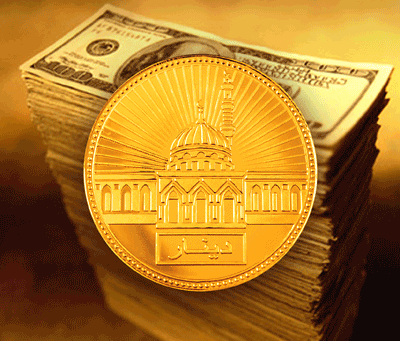
Global finance today dominates the world economy. Western economies are characterised with financial sectors which generate billions for the economy. Stock Markets, multinationals, companies raising billions, initial public offerings (IPO) and so on, all symbolise the apparent success of Capitalism. Finance is important in any economy for two fundamental reasons:
1. Whatever is produced in any economy can only be bought and sold through the use of money.
2. Society is looking to increase its wealth through investment. The financial sector exists today primarily to bring those with money, and those who need it together.
Finance: Past and present
Capitalism has dominated the financial scene for over 300 hundred years. The initial development of the stock markets took place in Europe to fund expeditions to Latin America, where merchants went to gain riches. Most of the developments in finance have taken place in the post WW2 era.
The purpose of finance is to bring those with money and those that need it together in the market place. The first time the world's largest economies got together to discuss global finance was at the Breton Woods conference in 1944, this was the first attempt at unifying the terms of global finance. There were two important outcomes from the conference:
The pegging of the worlds currencies to the dollar which in turn was pegged to Gold and the blueprint to remove all barriers to finance so financial transactions could take place freely. Financial dealings increased twenty fold and reached astronomical proportions. When the US abandoned the dollar peg to Gold, this brought even more money into the financial markets. The explosion in finance meant more and more money was being invested in the financial markets, the need to keep pace with such a development required ever more money to fund such investments and with the absence of a peg to Gold this period witnessed an astronomical rise in the printing of money.
The deregulation drive during the Thatcher-Reagan era brought even more participants into the financial markets including individual investors looking for riches. This also saw the development of the derivative markets in the 1990's where money was speculated on the movement in the shares of companies, currencies and interest rates. For the first time traders were allowed to speculate in a commodity without actually buying or selling the actual commodity.
Over a period of 300 hundred years the emergence of fiat currencies (i.e. currency without an intrinsic value), the role of compound interest and the development of limited liability company structures have shaped western finance.
Such developments have also been the sole reason why the West has come to be characterised with regular financial crises. The developments in finance since WW2 brought to an end industrial dominance and created duel economies. This is because the financial sector moved away from raising finance to fund business start-ups and projects to speculating on company share prices and the movement of currencies. In this way trading in the financial sector ceased to be about purchasing currency or buying shares in the hope of receiving a dividend to purchasing financial commodities in the hope they could be sold for a higher price.
Due to this it became possible for a company to be in financial difficulties but have a rising share price, or as was seen during the dot.com bubble, new start-up's witnessed astronomical rises in their share prices even though they were forecasted not to make a profit for 20 years.
The financial sector dominated by the financial markets actually does not produce anything real. Speculators trade in shares, bonds, and currencies that move around from trader to trader, in the hope that slight price changes will yield profits. This process has led to speculation reaching levels unheralded in history. It also means the price of commodities could be moving in the complete opposite direction to the supply and demand situation of a commodity. A good example of this was the rise in oil prices in 2008. Oil prices in less than a year reached $150 a barrel. Throughout history Oil prices rarely went above $35 a barrel, this huge surge in price completely contradicted the fundamentals. No new oil fields were discovered, no new technology was invented that could extract or refine oil quicker. Mark Lewis from Energy Market Consultants explained at the time in a BBC interview: "We really don't know what the fundamentals are doing at any point in time; the markets are looking for signals from the fundamentals. Some of them are irrelevant, some of them are wrong, some of them are meaningless, but they affect prices nevertheless." Sean Cronin, editor of Argus Global Markets explained at the time: "When the New York oil price broke through $100 a barrel for the first time at the start of 2008, one of the factors cited as being behind it was the assassination of Benazir Bhutto in Pakistan on 27 December 2007, that didn't strike us as making any sense at the time."
The financial economy that doesn't produce anything has become so sophisticated that various products have been created which allow an investment in a paper with no real asset represented. This side of the economy is valued more then the real economy, the size of the worldwide bond market is estimated at $45 trillion. The size of the world's stock markets is estimated at $51 trillion. The world derivatives market has been estimated at $1000 trillion, more then 60 times the size of the US economy and 24 times the size of the entire world economy.
Disaster Capitalism
Western theories on finance have dominated the discipline of economics for over a century. Economic textbooks argue the ‘time value of money' theory which states that the value of money (the quantity of goods that can be bought) is falling hence a mechanism is needed to fill the difference. Hence £100 will purchase a fixed amount of goods today, however a year later £100 will not get you the same amount of goods, interest rates in theory are equal to the difference. The ability to invest in investment products and financial markets allows one to hedge his/her wealth.
The fundamental problem with such Capitalist theory is that on many issues there is a wide discrepancy between theory and practice. Interest rates in today's global economy in no way represent the change in the value of money. Interest rates in many economies across the world outstrip prices changes enormously. Such views of money have in fact created an economy which is not real. The global financial economy has turned into one big casino where traders bet on what will happen in the real economy.
Islam and the Financial Economy
The Islamic economy is built upon the real economy this is where the process of production of tangible goods and services, Islam has designated a role for finance in the economy - due to Islam's focus on the real economy which is the wealth creating aspect of any economy finance in Islam is not an end in itself as there is no interest (Riba). Wealth in Islam is created through each stage of industry i.e. mining, refining, manufacturing and sales' All of this adds value at each stage and creates wealth for the economy.
ذَلِكَ بِأَنَّهُمْ قَالُواْ إِنَّمَا الْبَيْعُ مِثْلُ الرِّبَا وَأَحَلَّ اللّهُ الْبَيْعَ وَحَرَّمَ الرِّبَا
"That is because they say: ‘Trading is only like Riba,' whereas Allah has permitted trading and forbidden Riba." [al-Baqarah, 2:275]
Finance in Islam is intrinsically tied to the real economy and is not an industry in itself. Due to this finance takes a shape in an Islamic economy very different to what is seen in Capitalist economies.
1. Money in Islam was designated by Prophet Muhammad صلى الله عليه وسلم as representative money. This is where the notes and coins in the economy are representing a commodity. Through the actions of Prophet Muhammad صلى الله عليه وسلم in terms of collating tax, penalties and prices in the economy, money represents gold and silver. By restricting the legal tender to such metals inflation is contained as any increase in the supply of money requires additional metal, in this way the Islamic economy has restricted the central government from freely printing currency (paper money must be 100% backed by gold or silver). This brings the much needed stability to money which in turn brings stability to the overall economy.
2. The Bait-ul Mal - the central treasury plays a key role in an Islamic economy. It regulates Money supply by monitoring production and ensuring sufficient currency exists in the economy so that trade and transactions can take place. The role of the state has been clearly defined in the Islamic texts. It has been designated with the responsibility of ensuring the circulation of wealth and supervising the public properties.
3. The removal of interest has a huge impact in the economy. For many it is difficult to envisage economic life outside the capitalist framework which relies so much on interest. The absence of interest actually allows for more wealth creation. To appreciate this we need to understand the role played by interest in investment decisions. This is because the challenge all people face is one of investment. Simply put, people will only invest their money if the rate of return of a business venture measured against the risk of the venture is offset by the interest that can be gained from leaving the money in a bank account to accrue interest. Thus, if the risk of the rate of return on an investment is less than the rate of interest, then one would leave their wealth in a bank account rather than actually invest it. Hence the incentive would be to save the money rather than to use (invest) it. Interest in other words restricts investment and hence is an impediment to the distribution of wealth. By removing interest from the economy it incentivises wealth circulation in the economy through investing in real goods and business ventures. This brings added stability as all participants participate in the same sphere - the real economy.
4. Any individual wanting to begin a business venture needs finance. One could wait for years to accumulate the necessary profits to expand or start a new business or borrow the money today. For this purpose banks were created. Islam has permitted the creation of banks and views them as institutions that aid wealth circulation. This is because banks collect the population's deposits and then invest the money across the economy in new business ventures. In this way banks become like venture capital bodies who invest in real business. With the absence of speculative financial markets banks only have one sphere to invest customer wealth, the real economy. The absence of interest in the Islamic banking industry as well as speculative and dubious financial markets is the discerning line between modern banks and Islamic banking. This means Islamic banks can only make money from investing wealth across the economy in projects and new start ups, the impact on the wider economy is huge as banks will stimulate the economy through such acts. Modern banking wealth finds its way primarily into the financial markets creating a speculative bubble if investments do not materialise.
5. Although Islam is built upon the real economy and the financial sector is based upon providing finance for the real economy, Islam has allowed a few purely financial transactions. Islam has permitted currency exchange as this was a common practice amongst the people of Mecca and Medina and Muhammad صلى الله عليه وسلم did not object to it. Islam permitted some forward contracts - this is where payment is taken before the actual delivery of goods or before the final transfer of ownership of the goods. However the items that can be sold before ownership is undertaken must be of a defined nature where they can be counted, measured or weighed, this is due to what is established in the hadith of ibn Abbas, that the Messenger of Allah صلى الله عليه وسلم said: "Whoever pays in advance in dates, let him pay in advance for a known price and a known weight for a known period."
And in another narration of ibn Abbas who said:
The Messenger of Allah صلى الله عليه وسلم said: "Whoever pays in advance in something then (it should be) in a known measure and a known weight for a known period." (narrated by Al-Bukhari)
Islam has categorically prohibited purely financial transactions where one lends money in the hope of receiving more in repayment. All trade and transactions are linked to the real economy as they are built upon construction, manufacture, services, or the production of goods and so on.
6. The Islamic company structure also complements an economy without interest. This is because Islamic law does not allow companies to operate on the basis of limited liability, which allows one to only have a financial stake in a company which is restricted to the amount invested. In the event of bankruptcy a shareholder would only lose the initial capital of the company no matter how large the debts. The key feature in an Islamic company is all shareholders are responsible for company debts in proportion to their investment, rather than just their monetary amount. Islamic company shareholders also partake in the running of the business not merely just remain a shareholder in the hope that share prices rise. Stock markets exist primarily to cater for such investors, who do not directly participate in running or management of the company.
7. Whilst the Capitalist finance industry offers investors an array of products and many opportunities, it also brings much harm to the wider economy. This is because such debt based products are betting on the future and reliant upon a certain outcome, when this doesn't occur the inevitable bust occurs. The Global, credit crunch was built upon future real estate prices continuing to rise, when this was not forthcoming it brought the global economy down, as many had invested in debt based products which themselves were dependent on rising house prices.
8. Western theorists have always argued that an economy without interest removes the incentive to invest. They argue there would be no investment unless there was a guaranteed rate of return. The Islamic economy however is dynamic enough to encourage investment without the need for interest. The prohibition of hoarding wealth has been addressed directly by Allah سبحانه وتعالى, the Islamic creed has forbidden the hoarding of wealth. Hence spending is seen as an act of worship alongside the fulfilment of one's needs. At the same time the Islamic economy has designated a 2.5% tax (Zakat) on any wealth held for a year above a fixed threshold. Hence holding onto wealth aside from being rebuked by the Islamic texts faces taxation at the of the Islamic tax year - all this gives citizens in the Islamic economy the incentive to spend and invest, stimulating the economy.
Conclusions
The Islamic economy is intrinsically tied to the real economy, this means wealth is created at each stage of the production line, be it mining, refining, manufacturing, marketing or sales. Each of these sectors will need companies and finance to contribute towards the economy and it is here Islamic finance plays a role. Due to finance being tied to the real economy participants engage only in the real economy which creates stability as there is no way for national income to leave the economy - as such a parallel economy does not exist. The aim of the Islamic economy is to remove barriers to wealth circulation, Islam achieved this through the removal of the barriers that act as obstacles such as interest, speculative financial markets, income based taxation and fiat currency. Boom and bust will not exist in an Islamic economy as the Islamic economy is about ensuring wealth continually changes hands so all can profit from it, the aim of the Islamic economy is not perpetual economic growth, which has proven to be mission impossible.

Adnan
said:
|
FINANCIAL TRANSACTIONS: FORWARD CONTRACTS The general rule of Islam is that one cannot sell something they do not have ownership of. There are however exceptions to this: The salam contract is an exception to this, The rules of agricultural goods/farming are an exception to the rule, “Whoever pays in advance for something, then it is in a known measure and a known weight and for a known period” (narrated by Al-Bukhari). People used to deal in salam contracts because they were in need of it particularly farmers and traders. The owners of crops and fruits need revenue on crops and fruits to complete what these require of work. They may be in need for funds and they do not have it, so they sell their produce before it emerges for an advance price which they take possession of immediately in the contract session on condition of delivering the good to the buyer when the agreed time approaches. The trader would sell the goods which they do not have up to a known/determined time which they determine, and they take possession of the price immediately in the contract session on condition that they deliver the good when the fixed/agreed time approaches. The permissibility of advance credit sale is established by the Sunnah. From ibn Abbas who said: “The Prophet (SAW) came to Madinah and they would pay in advance in fruits for one or two years so he said: Whoever pays in advance, let him pay in advance for a known/determined measure and known/determined weight for a known/determined time” (narrated by Muslim). |
|
|
report abuse
vote down
vote up
|
M Haji
said:
|
JazakAllah for your reply. It was very enlightening. Could you reply to the question of FINANCIAL TRANSACTIONS: FORWARD CONTRACTS as I think you mistakenly just copied my questions rather than your answers! JazakAllah |
|
|
report abuse
vote down
vote up
|
Adnan
said:
|
CURRENCY Many economists who support the idea of fiat currencies have argued for some time that there is not a sufficient supply of gold in the world for any nation to apply the Gold Standard. They argue by using the US as an example, the total amount of gold that has ever been mined has been estimated at around 150,000 tons. Assuming a gold price of $1,000 per ounce, the total value of all the gold ever mined would be around $4.5 trillion. The US today has $1.7 trillion in notes and coins in circulation but through fractional reserve banking has created $11 trillion worldwide. Hence, the amount of gold in the world would not be sufficient to back the amount of US dollars in the world let alone any other nation. However, the problem here is the fact that the US continues to print money or create it in its banking system freely without any restrictions. There is too much money in the world rather then not enough gold, because governments freely print money its purchasing power is always falling. Gold’s 5000 years history of being a unit of account and means of exchange created a stable purchasing power and this is why it was money for most of world history. Alongside gold, silver and precious stones have also acted as money which could again be money alongside gold. The truth of the matter is there is too much paper money in the world rather than a shortage of gold. Gold should be the primarily metal doe currency, sue to the perception the world has of it, however other metals can be used alongside Gold and Silver FINANCE AND THE ROLE OF BANKS In the case you have highlighted the company would need to borrow rather than distribute its profit, as any distribution of profits to a person makes them a ‘share’ holder and hence part owner. In the case o borrowing the same monetary amount needs to be repaid as and excess or shortfall would be Riba. The state will also give grants to those started a business in any of the key areas, so that will be another option to raise finance from. FINANCIAL TRANSACTIONS: FORWARD CONTRACTS I understand that the buyer can make payment for delivery of certain goods in the future. This could be that the seller has the goods but they are in a warehouse somewhere remote and will take time to deliver. However, can the seller sell the goods before he has them? Say if he hasn't actually bought them himself yet? Or what if he is a farmer and is yet to grow the crops for which he's entered into a forward contract? Is he allowed to do this? if so, what if he then cant fulfil the contract due to crop failure? TREASURY OR BAIT UL MAAL This question is really an administrative issue, In the UK the central bank is now a non-ministerial department hence it sets interest rates independently as well as money supply (although the government has some influence over this) In the Khilafah the functions of the treasury and central bank will be within the mandate of the bait ul maal |
|
|
report abuse
vote down
vote up
|
M Haji
said:
|
Salams brother. Thanks for your reply. And at the risk of repeating myself.. a great article. I read it again and have some more questions/comments that I would be very grateful if you would clarify CURRENCY I heard a counter argument used by those opposed to a return of the Gold Standard saying that there simply was not enough gold/silver in the world to faciliate global commerce. If there was a shortage of supply of gold/silver, would that not act as constraint on economic growth in the Islamic model (as they are finite precious metals)? FINANCE AND THE ROLE OF BANKS What is the Islamic models solution to those wanting to borrow from banks but who do not want to give away portions of their company but still need capital to start or to expand? Could an Islamic bank say, OK I will lend you £100K but I want £120K back over a 10 year repayment period? (The £20K being the banks profit). FINANCIAL TRANSACTIONS: FORWARD CONTRACTS I understand that the buyer can make payment for delivery of certain goods in the future. This could be that the seller has the goods but they are in a warehouse somewhere remote and will take time to deliver. However, can the seller sell the goods before he has them? Say if he hasn't actually bought them himself yet? Or what if he is a farmer and is yet to grow the crops for which he's entered into a forward contract? Is he allowed to do this? if so, what if he then cant fulfil the contract due to crop failure? TREASURY OR BAIT UL MAAL In the West, there are central banks and the governments treasury. How do they compare to the role of the Bait ul Maal. Is it correct to say 1) the treasury collects all the tax like the bait ul maal. 2) the central regulates the money supply like the bait ul maal? But isn't changing the money supply a government decision? Jazakallah for all your help/time. |
|
|
report abuse
vote down
vote up
|
Adnan
said:
|
The effects of money All ideologies have different schools of thought, mainly such school exist in legislation, hence liberals believe societies laws should be immediately replaced with liberal laws, whilst the left believe such laws should be gradually replaced. In economics there are also different schools of thought, the defining aspect of such schools in the Capitalist World seem to centre on the level of government involvement in the economy. The Keynesian school is famous for the level of government involvement in the economy, whilst the monetarists who were led my Milton Friedman advocated the removal of the government in the economy – i.e. pure free market. Both of these schools had influence on the governments of the day in terms of their policies. The monetarists take the view of more money in the economy means no need for government involvement to generate economic activity. They also understand that for economic activity to happene people need to trade, hence money is the means that allows trade. So the more money in the economy, more trade can take place – unlike products money really only has one use. The problem here is that this is really only the case in some circumstances. If an economy is generating $14 trillion dollars, like the US, then you need a sufficient amount of money in the economy so this wealth can change hands, if there isn’t this means that economic activity will come to a halt, whilst if there is too much money in the economy then there is too much money chasing fewer goods and this leads to the price of goods in an economy to rise. Capitalist economists for some reasons believe that inflation is just part and parcel of life, so instead of getting rid of it, its best to have little inflation, There is also difference of opinion on the causes of inflation so this leads to many governments to use printing money as a tool. If this tool was removed as a means to drive the economy all you have left is fiscal policy i.e. taxation and this would be unpopular for any government. The UK government has printed well in excess of £1 trillion in the past two years, the UK economy is only worth £1.4 trillion, the nations debt is around the same too. Expect some mega inflation when this money trickles through the UK economy, such money can take up to 2 years to go through a national economic system |
|
|
report abuse
vote down
vote up
|
M Haji
said:
|
Another great article. You wrote "in the west the assumption is the more money in the economy (when printed) will automatically lead to economic activity, which is false as prices rise". Could you elaborate? Why does the West think that more money will increase economic activity? Why are they wrong to think that? What are your thoughts on what the UK government is doing now (printing more money and pumping it into the economy)? Jazakallah. |
|
|
report abuse
vote down
vote up
|
Adnan
said:
|
Inflation is a universal economic concept, it is generally defined as the overall persistence increase in an economies prices. The causes of inflation however vary and this is something which is specific to the type of economic system adopted. There will no doubt be inflation under the Khilafah, however the Khilafah due to a number of Islamic economic characteristics will contain inflation and the spouts of inflation that do occur will be due to real economic conditions and not artificial. Inflation in Capitalist societies is caused due to capitalists states having no peg to their currencies and printing money at will. This situation leads to the amount of money in the economy to greatly exceed the economies output i.e. too much money chasing too fewer goods, and hence prices in the economy rise. In an Islamic economy money cannot be printed at will hence it is virtually impossible for the amount of money in the economy to outstrip output. With the Islamic currency being pegged to metal any increase in money supply will require further metal, which itself is economic activity hence the increase in money will also lead to an increase in economic output. All this means is that inflation will occur when as an example a bad harvest has led to less agricultural goods to enter the market, leading to the price of those goods that do enter the market to rise. This type of inflation is a natural consequence of economic activity and will in the long term balance itself out, in the west the assumption is the more money in the economy (when printed) will automatically lead to economic activity, which is false as prices rise. |
|
|
report abuse
vote down
vote up
|
sabu
said:
|
Dear Adnan Khan, Will there be any inflation in khilafah state? why or why not? |
|
|
report abuse
vote down
vote up
|
Adnan
said:
|
Investing other people’s money and agreeing a profit distribution ratio would come under Brokerage rather than partnership. A broker is a person who is employed by other people to buy and sell on their behalf. A commission agent is employed in the same way. Abu Dawud, in his Sunan, related that Qais ibn Abu Ghurza al-Kanani said: "We used to buy the Awsaq (loads or freight) in Madinah and call ourselves brokers. The Messenger of Allah (SAW)came and called us with a name which was better than ours. The Messenger of Allah (SAW)said: "O you merchants, trading is usually blemished with foolish talk and swearing, so blend it with sadaqah." Hence brokerage is similar to representation, where someone undertakes actions on your behalf. Banks under the Khilafah would need to make the delineation clear between deposits and investment accounts as they are different contracts |
|
|
report abuse
vote down
vote up
|
Yusuf
said:
|
Salam alaikum, I cannot see how banking is allowed in Islam, other than functioning as a safe deposit. Because lending other peoples money in investment schemes is not one of the partnerships that Islam has defined. When money is invested in an idea, the two or more who are a part of this investment becomes partners, either as a Mudharaba or through some of the other partnerships allowed by the Sharia. But a partnership in Islam requires the agreement of the partners in the specific commitment, and so a bank would have to know who´s money is used and the involved would have to agree on a partnership. You cannot just put all the money in a pot and then use it in some investment scheme and give people a share afterwards. So this "bank" would only serve as a sort of consultancy firm, putting people with ideas together with people who has money. So I really do not see the need for banking in Islam, only as a safe deposit, and this would be the responsibility of the state. If I am wrong could You please explain. Jazaka Allahu Khair |
|
|
report abuse
vote down
vote up
|
Adnan
said:
|
Anas reported: “Prices soared during the time of the Messenger of Allah صلى الله عليه وآله وسلم so they said to him; ‘O Messenger of Allah why don’t you introduce pricing (price controls)?’ He said; “Verily Allah is the Recipient, the Extender of wealth, the Provider, and the Pricer, and I hope that I will meet Allah (swt) without having anyone accusing me of having perpetrated an oppression against him be it in blood or in money.” The State will not impose price controls, but it will prosecute anyone colluding to distort the market, eg monopoly, or restricting supply to push up prices. Best antidote to the problem is for an open market where traders can freely compete. With many trading it is difficult for a few to collude to push up prices. |
|
|
report abuse
vote down
vote up
|
shabana
said:
|
salam, every year we hear of price hikes in the muslim world during ramadham. this just makes peopel more miserable and causes much hardships in already poor conditions the ummah find themselves in. How would the economic policies prevent such scandalous practices? Please exaplin or direct to appraorate reading material if possible. Jizaks. |
|
|
report abuse
vote down
vote up
|
Adnan Khan
said:
|
The word Bank traces its origins back to the Roman Empire, where moneylenders would set up their stalls in the middle of enclosed courtyards called macella on a long bench called a bancu, from which the words banco and bank are derived. As a moneychanger, the merchant at the bancu did not so much invest money as merely convert the foreign currency into the only legal tender in Rome—that of the Imperial Mint. The name bank derives from the Italian word banco "desk/bench", used during the Renaissance by Florentine bankers, who used to make their transactions above a desk covered by a green tablecloth. However, there are traces of banking activity even in ancient times. The word bank is a loose term, which encompasses activities such as money lending, deposits etc. For these reasons today westerners whenever they speak about Islam banking its always ‘Islamic finance’ or ‘Islamic banking’ to signify that it’s a particular type of banking – primarily no-interest based. I don’t think there is anything wrong with using the term ‘bank’ in Islam, in fact you will find many foreign terms have been arabised, such as the Greek silver drachm is the origin of the Islamic Dirham, the Roman Dinara is the origin of the Islamic Dinar and even Iqtisadah (economics) was arabised from the Greek language. The issue is banking is universal, interest based banking is a Western concept, therefore its specific to them. |
|
|
report abuse
vote down
vote up
|
Waqar Ahmed
said:
|
My question to your last post ""Islam and Finance"" on khilafah.com is pending your answer. Waqar |
|
|
report abuse
vote down
vote up
|
Waqar Ahmed
said:
|
BANK has a specific meaning in capitalisitic economic system. Is it correct use the same term for such an institution under islamic economic system. |
|
|
report abuse
vote down
vote up
|
Adnan Khan
said:
|
Banks play a key part in any society, they are able to collect customer deposits and then lend money in large quantities. If one wants to expand a business, they could either wait years for profit accumulation or borrow money from a bank and then repay the bank over a number of years. Hence banks play a crucial role in the economy spreading wealth around the economy. There are however some fundamental differences between banking in Islam and Western banking. In Islam there is no concept of fractional reserve banking which is at the centre of Western banking. Thus a bank in Islam cannot lend more than it has in deposits. Practically Banking in the Khilafah will work by having two sections to it, the first will be the normal deposits that many place with banks for safe keeping, in return for maybe a debit card to make payments. The second section will be where customers actually place money with banks so the wealth is invested and then the returns are distributed amongst all the customers who have essentially placed money in this pot. It is this section where the banks experts will invest money in the real economy, in new start ups, business and even become partners in other projects. Investing money on behalf of other people is wikala i.e. representation, hence it takes this rule as the shari’ah permissibility, as long as customers have given permission to the bank to do this, this is something permissible. |
|
|
report abuse
vote down
vote up
|
Waqar Ahmed
said:
|
Great work.. i have two questions... [1] Can you explain in more detail how Banks will function under khilafah. [2] How (why) banks are allowed to invest money of their custmoers in the real economy. Can you provide Sahri evidences. Jazakallah |
|
|
report abuse
vote down
vote up
|
Zeital
said:
|
Capitalism has dominated the financial scene for over 300 hundred years. The initial development of the stock markets took place in Europe to fund expeditions to Latin America, where merchants went to gain riches. Nice article showing practical applicability of how Islam can effectively solve hindrances to a stable economy. Towards the introduction a mention is made of Capitalism dominating Europe and eventually the globe over the last 300 years. A follow on article outlining the history and development of Capitalism would be insightful. Over the last 300 years, many critics and analysts from Europe had already noted Capitalism’s failing and potential drawbacks (in spite of Capitalism making some nations or more specifically individuals very wealthy). Adam Smith, David Ricardo, Henri de Saint-Simon, Immanuel Kant, Georg Hegel, and Karl Marx, (who had studied the earlier works of all these thinkers and synthesis their works in his volumes of Capital), all provide detailed social commentary on the ‘political economy’ and connections of ‘labour’, ‘commodities’ and ‘wealth’. The 1700’s and 1800’s saw huge financial catastrophes, and banks were regarded with suspicion and concern by governments (such as the U.S.A) and prominent leaders. Capitalism emerged from Mercantilism. The great commercial and centres of banking were in Genoa and Venice. These City States commanded huge commercial empires that rivalled entire European Kingdoms, and wielded immense diplomatic influence. With the rise of the European Nation State, (beginning with France) the Empire of the City, such as Venice found it increasingly hard to compete with the emerging nations. The City of Amsterdam in the newly independent United Provinces (The Netherlands) became the financial centre. The Latin Empires of Portugal and Spain had made lucrative profits on the international trade with the Far East and the plunder of natural resources from Latin America. The Dutch Golden Age saw the founding of the first Multinational Corporation (Dutch East India Company) which was financed by shares and also establishment of the first modern stock exchange. Already the balance of world trade was shifting towards the Atlantic (with the rise of Spain and Portugal). The Dutch would develop as the first modern Capitalist state with lucrative trading monopolies in Asia (and undermine the Portuguese position. The Dutch in turn would be displaced by the larger states, France and England (Great Britain after union of Scotland and England). Whilst Venice declined as a Great Power, the financial centre of global finance and commerce shifted from the Mediterranean and East Asia, towards the North West Atlantic. Spain and Portugal declined, whilst the economies of Britain, France, and the Netherlands were stimulated (including the bitter trade wars) and respective companies funded by national banks would support the Capitalist expansion overseas and quest for new colonies, exclusive trading rights, and ultimately the great rival clashes of the 1800’s. This is where the modern world was forged, with the nation state needing a strong economy, raise credit from banks, support standing armies and expand before rival nation states. |
|
|
report abuse
vote down
vote up
|
guY-sir
said:
|
Salaam to all my bros and sis very fastidiously written article and i'm trying to understand the whole islamic financial system. This article helps me alot to understand the Islamic financial system which we desperately need in these recession times. |
|
|
report abuse
vote down
vote up
|
Irfan Mehmood
said:
|
Assalamalikum brother.......... Great work i read it and got much out of it......... I wanted some explanation of point no.6 i mean if u could explain how does it work in Islamic system the shareholder thing......... and also give some examples of: "Modern banking wealth finds its way primarily into the financial markets creating a speculative bubble if investments do not materialise" Jazakallah |
|
|
report abuse
vote down
vote up
|
| < Prev | Next > |
|---|


