
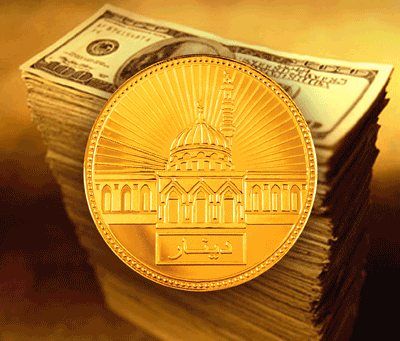
This Ramadan Muslims all over the world will choose this blessed month to fulfil the Islamic duty of paying their Zakat. For nearly 14 centuries Muslims have continued to pay Zakat collected by the ruler and distributed to the categories Islam ordained.
The rules of Zakat come under taxation, however they transcend taxation due to the wide ranging implications they have. Zakat is a source of revenue for the state and from an economic perspective they play an important role in wealth circulation. This is why Zakat is often compared to the system of tithing and alms but unlike these older systems, it also serves as a welfare contribution.
Linguistically Zakat means 'grow', 'purify', or 'foster,' like many Arabic words their meaning was changed and came to be defined in the Shar'ah as a determined right due from certain types of wealth.
Zakat forms part of worship (‘Ibadat) and is a basic element (Rukn) of Islam like prayer, fasting and Hajj. The Zakat is a personal duty (Fardh ‘Ayn) on every Muslim who possesses the minimum amount (Nisab) in excess of his debts for the duration of a year. Zakat is obliged upon Muslims only, and is not taken from others. Its obligation is established by the Qur'an and Sunnah. Allah سبحانه وتعالى says in the Holy Qur'an:
وَآتُوا الزَّكَاةَ
"Give the Zakat" [TMQ Al-Muzzammil: 20]
There are a number of hadith that indicate the obligation of Zakat: the Messenger of Allah صلى الله عليه وآله وسلم sent Mu'az to Yemen and said to him: "Inform them that Allah obliged Sadaqah upon their wealth that is taken from their rich and given to their poor."
Allah سبحانه وتعالى ordained harsh punishments to those who withhold Zakat. Abu Hurayra narrated that the Messenger of Allah صلى الله عليه وآله وسلم said: "No owner of gold or silver who fails to give its due right except that he will have sheets of fire made for him on the Day of Judgement. They will be heated in the Hellfire then used to burn his sides, forehead and back. Whenever they cool, they are reheated to him in a Day which is 50,000 years long, until it is judged between the people and he is shown his path, either to Paradise or to the Fire."
Economy
The Zakat revenues are one of the funds that are placed in the Treasury. It is different from the other revenues because its collection, in regards of with its collected amounts and in regards with its spending.
Islam restricted the sources from where Zakat is collected, it is collected from the wealth of Muslims only and not from the non-Muslims. It is, as well, not a general tax, rather one of the pillars of Islam. Besides this, paying Zakat achieves a spiritual value, like the prayer, fasting and the hajj.
The levying of Zakat does not proceed in conformity with the needs of the State, nor according with the interest of society as is the case with all the other types of taxes levied from the Ummah. It is a specific type of tax that must be paid to the Treasury, whether there was a need for it or not. A Muslim is not absolved of the duty to pay the Zakat when it becomes due on his wealth. Its payment is obligatory on the Muslim who owns the Nisab (minimum amount eligible for Zakat), after deducting his debts and his needs. Zakat is not an obligation upon the non-Muslim. It is however an obligation upon the adolescent and the insane, this is because At-Tirmidhi reported on the authority of Abdullah Ibn Amru that the Messenger of Allah صلى الله عليه وآله وسلم said: "He who acts as guardian for an orphan who has property, let him trade in that property and not leave it until the Sadaqah devours it", meaning that he should not leave it until it all perishes from paying Zakat upon it.
The disposal of Zakat and the areas of its expenditure have been determined and restricted to eight categories Allah سبحانه وتعالى mentioned in the Qur'an. Allah سبحانه وتعالى said:
إِنَّمَا الصَّدَقَاتُ لِلْفُقَرَاء وَالْمَسَاكِينِ وَالْعَامِلِينَ عَلَيْهَا وَالْمُؤَلَّفَةِ قُلُوبُهُمْ وَفِي الرِّقَابِ وَالْغَارِمِينَ وَفِي سَبِيلِ اللّهِ وَابْنِ السَّبِيلِ فَرِيضَةً مِّنَ اللّهِ وَاللّهُ عَلِيمٌ حَكِيمٌ
"The alms are only for the poor, and the needy, and those who collect them, and those whose hearts are to be reconciled and to free the slaves, and the debtors, and for the way of Allah (Jihad) and for the wayfarers." [TMQ At-Tauba: 60]
The poor, are those who have money, but their expenses are higher than what they own. Whilst the needy are those with no money and no income.
The individuals the state employs to collect and distribute the Zakat are also paid from the Zakat collections.
Those whose "hearts have been reconciled" are those the State deems appropriate to give them from the Zakat as an incentive to establish them firmly in Islam.
The slaves are also given money so that they can be freed. This category is not existent today.
Those in debt, who are unable to pay off their debts all receive a share.
In the way of Allah means Jihad; whenever "in the way of Allah" is mentioned in the Qur'an, coupled with spending, its meaning is Jihad.
The wayfarer is the traveler.
It is forbidden to pay Zakat to any other than from these eight categories, and it is also forbidden to spend it upon the other expenditures of the state.
Paying Zakat
Zakat is obliged on the following properties:
1. Livestock
2. Crops and fruits
3. Currency
4. Trading goods and merchandise
Zakat is obliged on these properties if they reach the Nisab for the duration of one year except for crops
With the absence of the khilafah, the role Zakat plays in an economy is absent in the Islamic lands, Zakat is not enforced by the Islamic lands although many Muslims willingly pay their dues. Without the Khilafah the obligation of Zakat remains as its not based upon the existence of the state, it is an obligation which has its own evidences, so it's obligatory for itself.
Livestock
Zakat is liable upon various animals if they are kept for year for grazing, the nisaab is different depending on the animal, and hence no Zakat is due on camels until they are more then five in number. Other animals that Zakat is liable upon are cattle, Lamb, Sheep and goats. The nisaab is progressive which increases with the number of animals.
Fruits and Crops
Zakat is obliged upon wheat, barley, dates and raisins. The texts which oblige Zakat upon fruits and crops came in restricted form, hence there is no Zakat on other fruits such as maize, rice, beans, chickpeas, lentils or other types of grains and legumes. Similarly, it is not taken from apples, pears, peaches, apricots, promenade, oranges, banana or other types of fruits. Again the nisaab rate is progressive. The Zakat due is based upon an estimation of the fruits that people have from their palm trees and grapes after their ripeness becomes obvious.
Trading and Merchandise
Zakat is liable on merchandise, this is everything other than currency which is used for trading, buying and selling, for the sake of profit e.g. foodstuffs, clothing, furniture, manufactured goods, animals, minerals, land, buildings and other goods that are bought and sold. Zakat on trading merchandise is obliged when it reaches the Nisab value of gold and silver, and a year has passed over it.
Gold, Silver and money
Zakat is also liable for Gold and silver that is held for a year. The amount levied, was determined by Muhammad صلى الله عليه وآله وسلم. It has been determined as a quarter of the tenth (2.5%) in gold and silver and the. The amount is levied from a specific sum, which is the Nisab or over. The Nisab equates to either 200 silver Dirhams or 20 gold Miskals. The gold Miskal is equal to a Shari'ah approved dinar, whose weight is 20 carats, which is equal to 4.25 grams of gold. Hence, the Nisab would be equal to 85 grams of gold. As for the silver dirham, it is equal to 2.975 grams, thus the Nisab of silver would be 595 grams of silver. If the amount was less than the Nisab, nothing would be taken from it.
Zakat was obliged upon the two currencies, which were Gold and Silver at the time of Muhammad صلى الله عليه وآله وسلم. As today's currencies are paper based, they still carry the characteristics of currency as well as the characteristics prices, they therefore come under the Ahadith obliging Zakat on the two currencies, gold and silver. Hence any dollars or pound sterling held for over a year above the rate of nisaab would be liable for Zakat.
The weight of Gold and silver rates below are the Shari'ah rates, this need to be used to calculate Zakat.
|
|
Grams |
Tolas |
Grains |
Troy Oz. |
|
GOLD |
87.48 |
7.5 |
1350 |
2.8125 |
|
SILVER |
612.36 |
52.5 |
9450 |
9.6875 |
Conclusion
Zakat form a fundamental aspect of the Islamic economic system, unfortunately with the absence of Islam in the Muslims lands, wealth although in abundance remains with the few who live in poverty. Its important Muslims view Zakat from an Economic perspective and not only as an individual practice as Zakat practically can only be implemented with the establishment of Khilafah.
Please listen to Sheikh Issam Ameireh (al-Quds, Palestine), speaking on Zakat and answering some of the questions raised by our readers below. Click to listen.

Abdul-Kareem
said:
|
wa salam, The specific category mentioned in the Qur'an Al-Aamileena alaihaa applies to those zakat collectors appointed by the Khaleefah or his representatives such as the wulah (governors) or the amil (mayor). This does not include charity organisations and their collectors today. Here is a nice article addressing this specific question. Can Salaries Counts as Zakat? http://qa.sunnipath.com/issue_...469&CATE=5 |
|
|
report abuse
vote down
vote up
|
Shabeeb Hassan
said:
|
Bismillah Assalamu alaikum varahmathullah Should Zakath be paid only to Individuals. what about Amileena alahiha (Those who collecting zakah) . The organization which is acting as the collectors are included under such category. Can we give part of zakath fund to da'wa organization under Fee Sabeelillah? Pls clarify Jazakallah Wassalam |
|
|
report abuse
vote down
vote up
|
Abu Musab
said:
|
Muhammad Waqas Munir. Yes you can give Zakat to your father-in-law as long as he fulfills the conditions for receiving zakat. |
|
|
report abuse
vote down
vote up
|
Muhammad Waqas Munir
said:
|
Sir, i have a question about zakat that can an boy give the zakat to his wife's father if he deserve it. |
|
|
report abuse
vote down
vote up
|
Adnan
said:
|
Gold ans Silver are considered stores of value, which is a charataristic of money. Hence Zakat was oblighed upon wealth, which is represented in money - money is therefore Gold and silver. As other currencies are also 'stores of value' they fulfill the charataristics of money. This is why there is differennt view on weather Jewllery should have zakat, as it is not a store of value, hence not money, therefore it cannot be considered wealth. Hope thats clear |
|
|
report abuse
vote down
vote up
|
Ahmed
said:
|
Salaams Could you explain in more detail why paper money is still subject to zakat. Some argue there is no illah upon paying zakat on Gold and Silver hence it is restricted to these commodities and cannot be extended to include other currencies not based on gold and silver. If you could please clarify this Jazakallah khayran |
|
|
report abuse
vote down
vote up
|
abdullah
said:
|
Question to Sheikh Issam Ameireh Sheikh 1. Is it better to give the zakat in small quantity to many or in a large quantity to one? 2. If i gave money to my children, in their bank account, would i pay zakaat on this? 3. Here in the west many buy houses (unfortunately they take loans on interests) however these loans are over many years. Would this be regarded as a debt? 4. If the loan was halal, would this make any difference - i.e. a loan of 100,000 for a house. 5. If you are a partner in a company, how do you pay zakaat on jointly owned stock? |
|
|
report abuse
vote down
vote up
|
Salman
said:
|
Question to Sheikh Issam Ameireh Salaam my brother, I understand that Zakat is not payed upon the gold and silver of jewelry according to the Shafi school and that the Hizb also has adopted this opinion. Can you confirm and explain? Jazaakallah khairun and salaam to all the brothers in al quds. ws |
|
|
report abuse
vote down
vote up
|
Anwar
said:
|
Question to Sheikh Issam Ameireh Salaam Sheikh I undertand that zakah can be given to certain needy relatives and this will mean there is double reward for the person who gives the zakah. My question is how can we judge if the relative is needy enough to qualify them to receive the zakah? An example is if an aunt lives in a muslim country, who's husband is not earning very much and rely on some finacial help from other family members for things like material possesions, medical bills, schooling for children -but are not experiencing any hunger/shortage of food and they have a home and are able to cloth themselves. Will such a person/family qualify? Please give us a general principle to apply. Also, is it a rule that zakah has to be given in such a way that no other person must know where you have given your zakah, and that the receipient of the zakah must not know that you hav egiven them zakah? Jazakallah khair |
|
|
report abuse
vote down
vote up
|
Masood
said:
|
Question to Sheikh Issam Ameireh The opinion of Hanafi's is that the zakath is not due for the weath posessed by infants. Is that right and is that a legitimate opinion? Because they say that prayer is not fard on infant and since he does not understand any thing then how can zakah is fardh on them? There is a hadeeth that talks about the zakah of orphans but what about the wealth possesed by the infants who are not orphans? |
|
|
report abuse
vote down
vote up
|
AH
said:
|
Question to Sheikh Issam Ameireh Assalamalikum, One question that I have not been clear about is the meaning of the one of the eight categories of people intended to receive zakat funds. Amongst the eight are those who collect the zakat. In origin it is a duty of the Islamic state to collect the zakat and it can use the zakat funds to pay for salaries etc of those who are involved in collecting the zakat. In our reality today , where there is no state, firstly is it allowed for organisations to take the duty of state in collecting the zakat. For example some organisations never talk about the states duty to collect zakat and that they are doing so on a temporary basis, rather they give the impression that they are normal route of paying zakat. This is different to some organisations that take zakat funds to distribute to people directly without implying that they are the normal way to pay zakat. Secondly, is it allowed for these organisations to take the funds from zakat as being one of the categories that is entitled to zakat from shara. Please can you clarify?Jazak Allahu Khairun |
|
|
report abuse
vote down
vote up
|
Abdullah
said:
|
Question to Sheikh Issam Ameireh I have some Montblanc pens in which there is some gold and silver . Do I need to pay zakat on them? |
|
|
report abuse
vote down
vote up
|
Abdul-Kareem
said:
|
Question to Sheikh Issam Ameireh Assalamu alaikum Sheikh, How do we calculate the zakat nisab on paper currency that is not backed by gold and silver? The current silver zakat nisab is approx. £142.70 and the gold zakat nisab is £1,418.43. Usually I calculate using the silver nisab to be on the safe side. |
|
|
report abuse
vote down
vote up
|
Adnan
said:
|
Question to Sheikh Issam Ameireh I have lent money to a few individuals, who will repay over a lengthy period of time. Do i still need to include the amount as wealth and part of the zakat calculation |
|
|
report abuse
vote down
vote up
|
Adnan
said:
|
The types of wealth liable for Zakat have generally been outlined in the article and are agreed by all the scholars in history, with some differences on a few issues. Zakat on Jewellery is one of them and the difference was between the Hanafi Madhab and the rest of the madhabs, based upon two issues 1. Is Jewellery considered like any other good, or are they considered as Gold and silver which is a medium of exchange which is liable for Zakat. Hence the Jurists of the Hijaz - Imam Malik and Imam Shaf'i mantained there was no Zakat on jewellery if it was for adornment and wearing. Imam Abu Hanifa and his disciples viewed zakat liable on jewellery. 2. There is also a conflict between a number of hadith, and the way in which they were reconciled is what also led to differences. Amr Ibn Shu'ayb narrated from his father 'that a women came up to the prophet accompanied by her daughter, who was wearing two Gold bracelets on her hands. He (saw) said to her, 'do you pray Zakat on these? She said no! he (saw) said would it please you if Allah were to put on your hands on the last day, two bracelets of fire.' She then took them off and placing them before the prophet said: 'they are for Allah and his messenger. It was related from Jabir that the prophet (saw) said 'there is no Zakat on Jewellery'. Amru b. Dinar said: “Jabir b. Abdullah was asked: ‘Is there Zakat upon jewellery?’ He said: ‘No’. It was said: ‘Even if they reach 10,000?’ He said: ‘Yes.’ Nafi’a narrated from ibn ‘Umar “that he used to marry off all his daughters for 10,000 and made 4,000 of that as jewellery. He said: ‘He did not give Zakat upon that.’ Abdur Rahman b. al-Qasim narrated from his father “that Aisha, the Prophet’s wife, used to look after the orphan daughters of her brother in her house. They had jewellery and she did not give Zakat of their jewellery.” The Scholars aside from the Hanafies do not accept the legitimacy of Amr Ibn Shu'ayb hadith, Abu Ubaid said of this Hadith: “We only know of it having been narrated in one way through a chain of narrators which people have criticised in the past and present. If the matter is like what is narrated, and it is reported from the Prophet, then it is likely to mean of the Zakat, the loan ‘Ariyya, as was interpreted by the scholars of whom we mention: Said b. al-Musayyib, Ash-Sh’abi, Al-Hassan and Qatada in their statement: “Its Zakat is its loan.” If Zakat on jewellery was obligatory like that on the Riqqa, it would have been like the rest of the Sadaqat that are common and known from the Prophet in the world through his letters and Sunnah. At-Tirmizi said: “There is nothing authentic in this chapter.” Hence depending on which Madhab one follows, the Hanafi's require one to pay Zakat on Jewellery as they consider it the same as Gold and silver and accept the hadith of Amr Ibn Shu'ayb. In this case the jewellery would need to be weighed at its market value, which would then be used to calculate ones wealth The remaining Madhabs contend there is no Zakat on Jewellery because through reconciling the conflicting evidences the hadith requiring Zakat on jewellery are outweighed. This is all regarding jewellery used by a woman. If it is taken by a man for his own use, he is required to pay Zakat. Whereas, if he takes them not for his own use but rather to give or lend to his wives, daughters or others then there is no Zakat upon them. This is because they are for a permitted use so there is no Zakat against him. If he takes them for business, then Zakat is obliged on them. |
|
|
report abuse
vote down
vote up
|
Tariq
said:
|
Question to Sheikh Issam Ameireh Do i need to pay Zakat on the jewlry my wife posses which is more then the nisab but is for her personal use???? Regards |
|
|
report abuse
vote down
vote up
|
| < Prev | Next > |
|---|


