
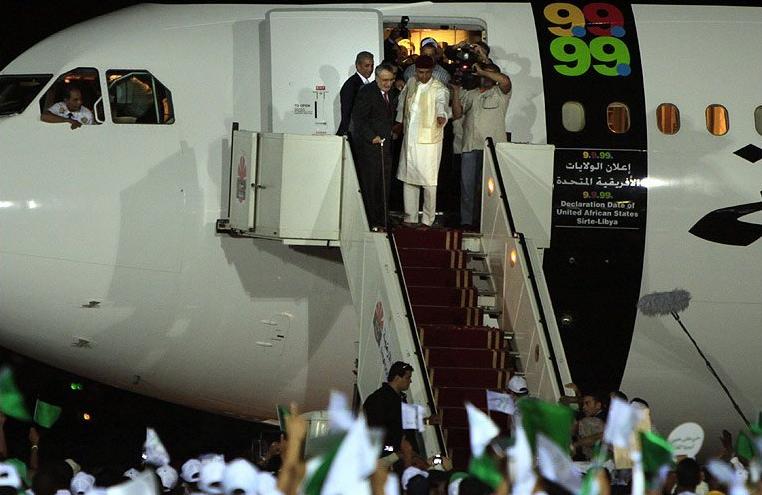
The public outrage at the release of Abdel Basset Ali al-Megrahi, who was convicted for the bombing of the Pan Am Flight in 1988 has also led to widespread condemnation of the Libyan regime over it's handling of the release of Al-Megrahi. The US has criticised the Scottish government for releasing a terrorist on compassionate grounds when he should have served his full term for the murder of 243 passengers.
Whist criticism of Libya has been fierce from the US, the European response has been mixed and centred around condemnation of the celebrity welcome Al-Megrahi received as he landed in Libya. In the United Kingdom, rumours are rampant that Secretary Peter Mandelson negotiated al-Megrahi's release in return for lucrative energy deals for British Petroleum in Libya.
There are however strategic reasons behind the UK and Europe's acceptance of Libya. President Hans-Rudolf Merz's of Switzerland offered an apology to Libya on the same day as al-Megrahi's release. Merz travelled to Tripoli to apologize in person for the arrest in July 2008 of Hannibal Gadhafi, the son of Libyan President Moammar Gaddafi and his pregnant wife by Geneva police, who claimed that the two were abusing their servants in a Geneva luxury hotel. The incident last year led the Libyan leader to cut off oil exports to Switzerland.
UK exports to Libya have risen to £280 million since Gaddafi was welcomed back into the international fold after years of sanctions. As UK foreign secretary David Miliband feebly denied the charge that Megrahi's release was linked to commerce with Libya, Jack Straw, the justice secretary, rushed through the ratification of the treaty that allowed the release of al-Megrahi, warning that a delay would damage relations with Libya.
Libya has Africa's largest oil reserves and at the heart of this incident is the simple fact that Europe's efforts to diversify away from Russian energy are leading the continent right into the outstretched arms of corrupt rulers like Gaddafi. Since the Ukrainian gas crises, Europe has attempted to diversify its energy sources away from Moscow, which has used its natural gas exports to achieve geopolitical goals.
It was during Tony Blair's tenure that Europe led by Blair worked diligently to rescue Gaddafi's government from the clutches of American neo-conservatives who after 9/11 wanted regime change in Libya. The only alternatives to Russian energy for Europe is the Middle East and North Africa and with the Persian Gulf firmly under US patronage countries such as Libya will find itself receiving much appeasement from Europe.
Despite talk of promoting ‘human rights' the UK and European governments only really care about securing economic and strategic interests. Hence, they are happy to do business with the most brutal government's who oppress their own people whether that is Gaddafi, the Saudi royal family, Mubarak or Karimov in Uzbekistan. When it comes to the Foreign Policy of Capitalist states, it is interests that matter - not principles. The empty words uttered by these politicians cannot mask their greedy actions. What this episode shows is that business interests mean more to both the UK and European governments than the lives of ordinary people - whether their own citizens, or the thousands of victims of Gaddafi's regime in Libya.

Zeital
said:
|
Anglo-American collaboration in the Near East and South East Asia also gives way to bitter rivalry between both nations. In spite of Britain and American leading the invasions of Afghanistan and Iraq, rounding against leaders of Libya and Sudan, or challenging regional aspirations of Iran and Russia; both Britain and America actively work to undermine the other’s interests. This Anglo-American rivalry had intensified prior to World War One, when the American oil companies developed an interest in Persia and Mesopotamia. Britain sought to maintain its monopoly in Persia and Mesopotamia following the conclusion of World War One. British warships fuelled by Persian oil sought to impose its authority upon the world’s major sea lanes. This hegemony over the seas raised cause for concern even in the U.S.A, echoing the concerns that Tsar Alexander had over a century earlier. With the dissolution of the Ottoman State, and Russia in turmoil following two revolutions; Britain sought to steal an advantage over oil fields in Mesopotamia, Persia, and Al-Hijaz (reorganised as Saudi Arabia). However Britain and France (although acquiring new mandates from former Ottoman and German territories) were financially and materially exhausted by the Great War. In addition there were numerous uprisings in Palestine, Mesopotamia, Syria, increased vocal demands of independence in Egypt and India; alongside the Turkish War of Independence, and Third Anglo-Afghan War. The cost of defeating the Central Powers and seizing the Ottoman territories came at a heavy price. On the horizon Imperial Japan was emerging in the Far East. ARAB AND PERSIAN NATIONALISM The conclusion of the Second World War affirmed the status of Britain and France as declining empires, and foreshadowed a post war period as dominated by two Super Powers. Decolonisation and bitter guerrilla warfare erupted in South East Asia, as countries like Indonesia and Indo-China struggled for independence from Netherlands and France. After the U.S.A rose to pre-eminence post 1941, America challenged the ailing British position in the Near East. British and French imperialism had long been unpopular with the inhabitants on Persia, Egypt, and the Arabian Peninsular. Post 1945, the U.S.A supported coups against British puppets and Britain responded by supporting assassinations against the American sponsored leaders. Saudi Arabia which had been a British scheme (incepted since the 1700’s during rebellions against Ottoman authority) became an American satellite and staunch ally. President Gamel Abdel Nasser of Egypt would be another staunch supporter of the U.S.A and stalwart for U.S interests in the Arabian Peninsular. This shrewd leader also utilised the popular sentiment for national pride, and sympathies of the decolonisation movements occurring in the Southern Hemisphere. |
|
|
report abuse
vote down
vote up
|
Zeital
said:
|
RETREAT FROM ASIA With India and Pakistan becoming independent sovereign states, Britain still sought to maintain its influence in the Near East; and sought to compensate the loss of India for seizing the oil wells of Persia, Mesopotamia, and retain bases in Aden and Southern Arabia. Nationalist leaders like Dr Mohammad Mossadegh and President Gamal Abdel Nasser sought to nationalise their state’s assets and eject British usurpation of their resources entirely. Prime Minister Mohammad Mossadegh nationalized Iran's oil industry but was overthrown by a CIA coup, with support from Britain in 1953. Newly emerging independent states like India, Indonesia, and Iran tended to follow Socialist models of development, with emphasis on developing heavy industries and manufacturing. The U.S.S.R provided assistance to many countries in the Southern Hemisphere with big construction projects such as dams and irrigation. Yet these countries after hard fought battles of independence faced threats from subversive activities of the U.S.A and Britain in plotting coups or instigating instability. In response to this new threat, these emerging states also sought to organise themselves along the Non-aligned’ movement, and keep apart from belligerent nations like France, Britain, and Netherlands, whilst avoiding becoming part of the rivalry between the U.S.A and U.S.S.R. Gamel Abdel Nasser was a founding member of the Non-Aligned movement alongside Josip Tito of Yugoslavia (a socialist state independent of the U.S.S.R), and Prime Minister Jawaharlal Nehru of India. The Bandung Conference of 1955 held in Indonesia promoted Afro-Asian cooperation against colonialism and neo-colonialism whilst remaining apart from global ambitions of the U.S.A and U.S.S.R. OPEN ANGLO-AMERICAN CONFRONTATION The Suez Crisis and secret Anglo-French pact with Israel to attack Egypt is a clear episode of Anglo-American friction over the Near East. Britain and France were major shareholders of the Suez Canal (which had been built by Egyptian labour), and the surprise Israeli military involvement was meant to knock Egypt out of the war and topple President Gamel Abdel Nasser. Both the U.S.S.R and U.S.A was furious with this plan, and the U.S.A withdrew its protection of Britain and France against potential Soviet actions. The Anglo-French alliance backed down. More recent history, such as the attack on Iraq in 1990 saw Britain striving to avert the U.S designs. The collapse of the U.S.S.R left a huge void, and the U.S.A was left unchecked as the sole superpower. This meant Britain could no longer play the U.S.A against the U.S.S.R (exhausting American economic and military power), and claim some share in the Southern Hemisphere. The collapse of Iraq under Saddam Hussein saw the lion’s share of the region pass into American control. Only Libya seems to be the British stooge as opposed to American expansionism. This party explains former Prime Minister Tony Blair’s desperate mission to Syria to retain some form of influence. British intelligence also worked to discredit American intelligence prior to the invasion of Iraq, and sought to smear the American standing in Asia and Africa. The U.S responded by challenging regimes allied to Britain and pulling them into the American orbit. |
|
|
report abuse
vote down
vote up
|
Zeital
said:
|
ANGLO-FRENCH DESIGNS IN AFRICA Since decolonisation in Africa, both Britain and France sought to maintain influence in important African states. France was ejected from Algeria after the bitter attrition and numerous casualties, (as was the case in Indo-China). Yet France still has a presence in Chad, Ivory Coast, Djibouti, and Central Africa Republic. France is involved in Francophone countries like the Democratic Republic of Congo and Rwanda (former Belgian colonies). Britain has close links with Libya (and ties with this country dates back to the aftermath of World War Two and Italy’s defeat). Italy had seized Libya from the Ottomans in 1912. Whilst Anglo-French ambitions collude with the U.S.A, such as occupying Afghanistan, isolating Sudan, supporting Ethiopia’s invasion of Somalia, or at times chastising Colonel Qaddafi; the U.S.A seeks to supplant these rival imperialist powers. British and French colonialism was a terribly bitter experience, so the U.S.A pursues the same goals, but with a charm offensive. Bill Clinton as a ‘Goodwill Ambassador’ and previously as President turns on the charisma to show the U.S.A as a ‘sincere’ friend to African states, like Kenya, South Africa, and Nigeria. AMERICAN CONNECTION Britain realised around the turn of the Nineteenth Century that it was in decline, having already experience economic depressions, and facing the vibrant industrial giants of the U.S.A, Germany, and potential Russo-German cooperation. The conclusion of two global wars saw Britain rest it’s hopes on preserving influence on American might. Yet Britain simultaneously would be a false friend to the U.S.A, secretly working to undermine American influence during the Cold War and attempted to cause dangerous provocations with the U.S.S.R. The U.S.A upon emerging triumphant post 1990, sought to arrange the global affairs independently free from the machinations of Britain, or potential rivalry from the European Bloc or the emerging economies of the Far East. Britain did support American objectives in trying to disrupt European attempts of unity and cooperation during 1960 – 1970. However, Britain cannot stand alone in world affairs, hence it needs formidable allies such as the U.S.A. Prior to 1941, France had been Britain’s main ally, but before 1815 Britain’s major ally was Prussia. Russia only ever entered into an alliance with Britain as a matter of urgency, preferring to build relations with major powers in Central Europe. This complex game of juggling alliance is what Britain exploited to establish an advantage over Great Powers consumed within their own rivalries, whilst expanding abroad. However, the U.S.A observed and developed a very astute awareness of this political game and now Britain has no alternative to play against American economic, industrial and military might. http://www.engdahl.oilgeopolitics.net/ http://www.henryckliu.com/ |
|
|
report abuse
vote down
vote up
|
Adnan
said:
|
US exposed Britain because fundamentally all nations work to protect their interests and weaken the plans others construct to achieve their interests. Although there were some US citizens that died in the Lockerbie disaster one will find the Anglo-British struggle is alive like it always has been, the US is organising the world which suits its vision and Britain is working to frustrate US plans, which it see’s as achieving its interests. Another example of this was when the US was going to war with Iraq, although Tony Blair stood by Bush, he reiterated continually the a UN resolution was needed, even though US had made clear that the UN was irrelevant, in this way the US was seen to have broken international law and this weakened its standing internationally, the UN resolution in fact frustrated the US as it delayed the war by 6 month’s. More on the competition between the worlds powers can be found in the book ‘Geopolitical Myths,’ - http://khilafah.com/index.php/...ical-myths |
|
|
report abuse
vote down
vote up
|
abdullah
said:
| why did america respond the way it did. ie why did it expose britain? | |
|
report abuse
vote down
vote up
|
Hassan
said:
| Just as importantly, we'll never forget the victims of the Lockerbie Bombing. | |
|
report abuse
vote down
vote up
|
A. S.
said:
|
Assalam-o-alaikum, U can insallah also read more about Lockerbie in Khilafah Magazine, October 2003, page 30. |
|
|
report abuse
vote down
vote up
|
Simoom,BD!
said:
| We'll never forget the brutality imposed upon the Shababs of HT by Gaddafi! | |
|
report abuse
vote down
vote up
|
| < Prev | Next > |
|---|


