
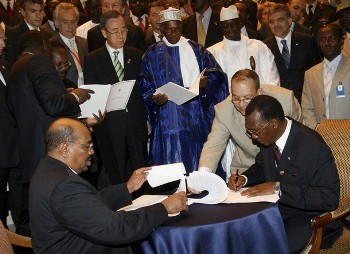
 On 4th May 2009, Sudan signed an agreement with Chad in Doha, under the joint auspices of Qatar and Libya. This agreement aims to cease mutual hostilities and prevent use of arms as a means of settling disputes between them as well as to operationalise their previous agreements. But the very next day Chad accused Sudan of sending an armed group to its eastern part, while on 15th May, 2009, Sudan charged Chad of firing two missiles from air on its territory. Chad acknowledged these raids and said that these were aimed at rebel mercenaries in Sudan who operate against Chad.
بِسْمِ اللّهِ الرَّحْمَنِ الرَّحِيمِ
Q&A: The Game Behind the Agreements between Sudan and Chad and the True Reality of the Conflict Between Them
On 4th May 2009, Sudan signed an agreement with Chad in Doha, under the joint auspices of Qatar and Libya. This agreement aims to cease mutual hostilities and prevent use of arms as a means of settling disputes between them as well as to operationalise their previous agreements. But the very next day Chad accused Sudan of sending an armed group to its eastern part, while on 15th May, 2009, Sudan charged Chad of firing two missiles from air on its territory. Chad acknowledged these raids and said that these were aimed at rebel mercenaries in Sudan who operate against Chad.
This Doha agreement is the 7th such agreement between the two countries, the earlier ones were signed in Tripoli (Moracco), Makkah, Riyadh and Dakar. Often it has so happened that whenever an agreement was signed, or such an understanding was reached, one of these parties has breached the agreement even before the ink on such papers dried. Each has accused the other of violating the terms of agreements and of supporting their rewspective rebels. These agreements have been little more than child’s play which they have signed but not complied with; they were like tools to deceive the other party while beleiving that they have honoured the agreements! Some times these agreements were signed merely to placate the mediating parties, only to return to their earlier manner soon after!
It appears that the conflict between the two countries regimes is destined to go on until atleast one of them falls to give way to a political alternative different from the current one. This is because the dispute between them is neither local nor regional, rather it has an international aspect to it, i.e. it echoes a conflict between big countries; France supports the Idrees Deby regime in Chad. In the midst of these events, the French Foreign Minister Bernard Kouchner addressed the Foreign Relations committee of the French National Assembly and said: “Sudan clearly bears responsibility at this stage of events because evey one is aware that thousands of rebels have infiltrated into the (Chad) border”. He added: “Everyone is watching and knows the irony that an attack was launched soon after the (Doha) agreement was signed at 8.00 p.m and on the next day, the rebels forces attcked from the Sudanese side.” [AFP: 22.05.09]. here Kouchner is not merely defending Chad while accusing Sudan of attcking, but his words imply as if France itself is a directly affected party which is under attack. It may be mentioned that the eastern region of Chad and the north-eastern regions of the Central African Republic has about 3700 troops from the European Union, most of them French soldiers. This testifies that France is backing the Deby regime of Chad and it is in her interest to defend him because it is Deby who is protecting the French influence in Chad and the surrounding areas for which Chad serves as the launching point.
As for Idrees Deby’s views on the cureent events, he has said: “Everyone who demands Deby’s ouster or destruction of Chad are mistaken, it will never happen”. [AFP: 22.05.09]. Thus he is fully aware that the rebels are opposed to him and his regime.
As for Sudan’s reaction to the events, Ali Siddiq, the spokesman of the Sudanese foregn ministry stated: “The Sudanese forces are fully prepared to hit back, but we are waiting for instructions”. [AFP: 17.05.09].
The government of Omar al-Basheer said that it has evidence implicating Chad in the chaotic events and of supporting the Justice and Equality Movement of Sudan which is fighting the Sudanese government in the Darfur region. [Radio Sawa: 18.05.09]. This indicates that the coming days will witness new events between the two countries and also that the rebels movements in both countries are linked to the happenings in Darfur. While the French activity appears to be through its agents and the rebels.
As for who is backing Basheer’s regime, it is the United States of America. We have seen how the US supported it at the International Court of Justice when Senator John Kerry, Chairman of the Senate Foreign Relations Committee and Republican party’s former presidential candidate, toured Sudan for three days just after the ICJ’s decision ordering arrest of Omar al-Basheer for a short period of less than a month and half. John Kerry, while meeting with several senior Sudanese officials, announced that he will work to deveolp relations between the two countries.
On 18th March, 2009, i.e. immedeately after the International Court of Justice’s ruling, the US administration appointed a presdential delegation under General Scott Grayson to improve relations with Sudan. John Kerry told a press conference in Sudan: “Thanks to the special efforts of the President Obama’s special delegation under General Scott Grayson and the willingness of the Sudanese government to enter into new dialogue with us, humanitarian activities will partially be restored”. He added: “The United States is interested in improving bilateral relations with Khatoum.” [AFP: 18.04.09]. He said: “I believe that the coming few weeks will witness improvement in one of the aspects like striking out the name of Sudan from the list of countries that support terrorism and also lifting of economic sanctions against Sudan.” He further added: “The US Presidential envoy General Scott Grayson has successfully begun this process and during his visit to Sudan this month and his visit which ended last week, he has laid the basic groundwork to build future relations between Sudan and the US and that his (Kerry’s) visit will provide a further boost to such efforts.” [al-Sharq al-Awsat: 18.04.09]. All this indicates American support to Basheer’s regime and that America stands behind him.
Thus the US will not abandon Omar al-Basheer’s regime just yet, it will work to support him directly and indirectly through its agents in the region like in Egypt and Ethiopia etc. Because since his coming to power in 1985, Bashher has easliy achieved all of US goals.
As for Idrees Deby, he has been a French agent in the region eversince coming to power in 1990 and has served France’s interests throughout. The rebels movements against him began in 1998 and have continued to oppose and openly challenge his regime to this day. One such powerful resistance movement has declared that it will launch an assualt before the rainy season, i.e. during the month of June next. The source said: “The Movement is not finished yet.” [AFP: 22.05.09].
This means that attacks will continue against the regime of Idrees Deby and may again threaten his regime directly as had happened during February last year when the rebels were able to reach Deby’s Presidential Palace and laid seige around it. Chad has already expressed fears of new attacks against it by the rebels; the Chad Defence Minister Adoum Younousmi stated that his country was preparing it’s armed forces to enter Sudan in the next few hours to preempt a new attack planned by the rebels in the areas along its eastern borders. [19.05.09].
It is in America’s interest to dethrone the Deby regime and replace it with its own agents in order to consolidate its stronghold and pillage its resources so that it can oust France from Chad which is financing the rebels in Darfur and working through them in order to strengthen its influence in the Darfur region by involving its agents like the Movement for Justice and Equality in Sudan and the faction of the Sudanese Liberation Movement led by Abdul Wahid who is now residing in France. On the other hand, America is using these activities to frustrate the French efforts and the International Court of Justice which is backed by the EU and particularly by France. These activities are designed to prevent the arrest and prosecution of Omar al-Basheer which will weaken the actions of the ICJ in this regard. The various parties are now taking recourse to the article 16 of the UNSC which provides for delaying arrests of the wanted men by the ICJ by a period of one year which is renewable.
Indeed, Sudan is vital for qall rival colonial powers in the region, be it the US or the European countries. Javier Solana, the EU High Representative of the Common Foreign and Security Policy emphasised the importance of Sudan when he said: “Sudan has not stabilised yet, its stability is fundamental for the entire African continent and the international community especially Europe which must move and take action to achieve results there.” He added: “The EU must continue to maintain its presence (in Sudan) at all levels, political, economic and humanitarian.”
Therefore the conflict will continue to rage in the region between the colonial powers i.e. the US and Europe until one of them has consolidated its control and repulsed the rival power, or the Islamic Ummah rises up and repels both of these parties from the region and assumes the administration of its affairs to solve its problems and the proxy systems prevalent in the Muslim world are dethroned erasing the articial boundaries between Sudan and Chad to unite them as part of a single state.
27th Jumadah al- Oulah, 1430 A.H
22nd May, 2009 C.E