
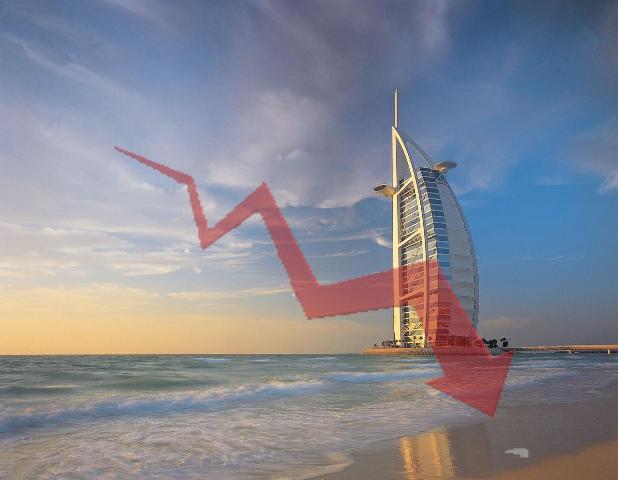
Whilst many have been looking at the prospect of global economic recovery, Dubai sent investors into a tailspin in December 2009 when the government revealed that it planned to ask creditors of Dubai World, the state-owned conglomerate, for a six-month standstill on its debt repayments, stopping short of defaulting. Dubai has $80 billion worth of debt, with the vast majority held by Dubai World, which owns Nakheel, the property developer.
Nakheel, which built the Palm Islands in the Gulf, was due to repay a $4 billion Islamic bond on December 14th 2009. Most investors had assumed that there would be no difficulty doing so as Dubai World, the Government of Dubai and Sheikh Mohammed bin Rashid Al Maktoum, Dubai’s billionaire ruler, were assumed to be supporting the developer. It now appears that nobody has the money to repay or refinance the bond and so the other $56 billion of Dubai World’s liabilities are also at risk.
Dubai’s rulers were considered to have provided a master class in how to develop an economy from almost nothing. They used what oil revenues they had to create a port and free-trade zone, believing that their little state could become a business hub if they created the right conditions. For many this was a shrewd move. Emirates, the airline, bolstered the hub and became the best possible mobile advertising banner. Dubai was considered a genuine economic miracle.
However the global economic crisis brought Dubai to its knees and has exposed the fragility of its economic model. Dubai’s growth was initially through its oil wealth. This wealth was used to develop Dubai in order to attract foreign investment and soon enough, foreign companies and foreign workers arrived looking for opportunities in Dubai. Its position as a trading hub meant many companies relocated their staff to work from Dubai which is fundamentally what brought Dubai its wealth.
This however was never sustainable. The skilled workers that were developing the service sector were mostly from overseas, with only a small percentage of Dubai’s population today considered to be native Arabs. Its growth has been a direct result of it becoming a tax-free zone for foreign nationals and companies. These companies, whilst providing jobs and income to people in the country, are not transferring any technical skills to the people. Its property market boom was due in large part to speculation that the prices would continue to rise.
Dubai has merely exploited limited natural resources and has been importing talent from abroad with little skills and knowledge-transfer to drive its economy. Dubai was always nothing more than a mirage in the desert; its growth and survival was dependent upon the talent and expertise of foreign entities. It could only offer specialist services such as banking and finance as a means to guarantee its future, along with tourism. As these sectors rely heavily on the goodwill and confidence of foreigners, if in any way this sentiment was affected, Dubai’s desert empire will crumble.
This is exactly what happened with the Global credit crunch. In order for financial companies to shore up their losses they have withdrawn their money from expensive and lavish projects. Service companies which relied on loans are now seeing this dry up as one bank after another either collapsed or required government bailouts. One expert from Nomura investment Bank encapsulated the situation in Dubai: “Lenders blinded by rising oil prices and borrowers spellbound by easy returns have helped build a mountain of private sector debt in parts of the region that has generated an illusion of excess and abundance.” As Dubai was built upon foreign money, it now awakes to find this has dried up, so in essence Dubai’s source of growth has been cut, causing the breakneck building-boom to come to a crashing halt. The lending bonanza has evaporated and the government continues to ponder wider steps to repay its debt, including asking its neighbouring emirate, Abu Dhabi, for financial assistance.
Dubai accumulated huge debt to construct the islands lavish towers and lavish lifestyle to attract foreigners. The development of the islands infrastructure led to Dubai borrowing large amounts of money in the form of bonds. Dubai even attempted to sell its development as a distinctly Islamic approach through the development of Islamic finance and through the sale of Islamic Bonds (Sukuk).
Sheikh Mohammed bin Rashid Al Maktoum has attempted to calm investor confidence through the tried and tested formula Western nations attempted on the eve of the global financial crisis with regard to the ‘fundamentals.’ Sheikh Mohammed said: “The economic fundamentals, such as our highly developed infrastructure, strong transport and communications hub and regional financial centre will ensure Dubai remains an attractive regional market.”
Islamic Economy
The suggestion that Dubai offered a new model for economic development and an Islamic approach could not be further from the truth. Building an economy upon foreign wealth, external expertise and personnel is a tried-and-tested model which has a substantial track record of failure. Latin America, South East Asia and the Baltic states have all attempted this approach with catastrophic results.
The development of the economy has extensive rules in Islam which have been elaborated by many scholars throughout history. Islam has made the Khilafah responsible for da’wah and the defence of the Ummah and this can only be achieved through a process of industrialisation. It also obliged the Khilafah to organise the fulfilment of the basic necessities of the people which are food, clothing and accommodation. This cannot be achieved by having an economy geared around services but needs one geared around manufacturing and agriculture. This allows a nation to produce all that it needs and export any surplus. Relying and depending on imports and foreign money is not an assured path for development and survival.
The Islamic economy also makes the aim of the economy the catering for it citizens, not foreigners. To attract foreign industry, labour and money, Dubai has had to compromise on many Islamic values to do with the mixing of the sexes and alcohol in the name of necessity. The imposition of some Islamic rules in reality is a charade. Islam has a framework for the economy and Islamic finance forms one aspect of its detail. The mere existence of some Islamic financial contracts does not make a nation Islamic. Britain was one of the first nations in the world to offer Islamic bonds yet nobody would argue that Britain has an Islamic economic system.
The Islamic economic system has extensive rules for ownership and disposal of citizen’s wealth and assets. Beyond this Islam recognises a sphere of the economy as the economic science i.e. through study and research a solution can be derived. Hence how to develop and economy or to industrialise, where the factories and the supply lines should be, how the steel and iron mills should be constructed fall under this category, however what is produced and how it is distributed falls under the ‘system’ for which Islam has extensive rules.
The Islamic economy is based upon wealth generation where participants partake in investment, employment and trade in the real economy. Islam does not have a dual economy where the real economy operates alongside a financial sector. The Islamic economy focuses all participants on the real economy, through employment, company profits, utilisation of land (agriculture) and manufacturing. This brings the huge benefit of wealth only circulating in one sector – the real economy, where all can participate.
The Islamic economy is built upon the real economy this is where the process of production of tangible goods and services, Islam has designated a role for finance in the economy – due to Islam’s focus on the real economy which is the wealth creating aspect of any economy finance in Islam is not an end in itself as there is no interest (Riba). Wealth in Islam is created through each stage of industry i.e. mining, refining, manufacturing and sales’ All of this adds value at each stage and creates wealth for the economy.
Islam’s monetary policy is centred around a legal tender based upon the Gold and Silver and not one based upon interest rates to regulate inflation and the economy. In Islam when it comes to exchanging a commodity with a specific monetary unit, Islam has guided Muslims to the monetary unit by which the exchange is to take place. It has restricted the Khilafah to a specific type of money, which is gold and silver. The Islamic evidences have designated gold and silver as the primary measuring unit for prices and labour. This is understood from the actions of Muhammad صلى الله عليه وسلم when he collected Zakat, levied taxes and imposed fines, all were measured according to gold and silver. This means the notes and coins circulating in the economy would all be backed by gold and silver. This will no longer make possible the free printing of currency as the Khilafah would need to increase the actual holdings of gold and silver. This has a unique effect on Inflation which free market economies have been unable to contain.
Although Islam is built upon the real economy and the financial sector is based upon providing finance for the real economy, Islam has allowed a few purely financial transactions. Islam has permitted currency exchange as this was a common practice amongst the people of Mecca and Madina and the Prophet صلى الله عليه وسلم did not object to it. Islam permitted some forward contracts – this is where payment is taken before the actual delivery of goods or before the final transfer of ownership of the goods. However the items that can be sold before ownership is undertaken must be of a defined nature where they can be counted, measured or weighed, this is due to what is established in the hadith of ibn Abbas, that the Messenger of Allah صلى الله عليه وسلم said: “Whoever pays in advance in dates, let him pay in advance for a known price and a known weight for a known period.” And in another narration of ibn Abbas who said: The Messenger of Allah صلى الله عليه وسلم said: “Whoever pays in advance in something then (it should be) in a known measure and a known weight for a known period” (narrated by Al-Bukhari). Islam has categorically prohibited purely financial transactions where one lends money in the hope of receiving more in repayment. All trade and transactions are linked to the real economy as they are built upon construction, manufacture, services, or the production of goods and so on.
In conclusion it will not be surprising if Dubai eventually defaults on its debts, this is because the cash line for Dubai has been cut, which was foreign wealth entering the nation and going into lavish projects. Dubai could have utilized the foreign expertise and developed oil refineries in the region which although blessed with huge oil reserves lacks the necessary refineries. Instead it was duped by the notion of hyper finance and geared its economy around finance, which may bring some wealth, but it does not give a nation any skills or technical knowledge. Bankers have lost all credibility in the West due to inventing dubious financial products. Dubai could have taken a lead in constructing the 21st century’s first Islamic economy and unified with the wider Muslim world that are blessed with mineral resources. Success only lay’s with Allah سبحانه وتعالى deen
إِنَّ الَّذِينَ يُحَادُّونَ اللَّهَ وَرَسُولَهُ أُوْلَئِكَ فِي الأَذَلِّينَ
“Indeed, the ones who oppose Allah and His Messenger – those will be among the most humbled.” [Al-Mujaadila, 58:20]