
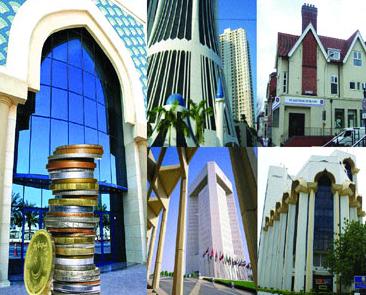
 Open up the pages of any newspaper or Financial Magazine and you are guaranteed to find advertisements from banks announcing their latest Islamic finance products. Once perceived as a niche market, Islamic finance today is big business with both local and international banks keen to get in on the act. An increasing number of non-Muslims are adopting Islamic compliant products as awareness of the principles behind Shari’ah finance has grown. In 2008, at least $500 billion in assets around the world were managed in accordance with Shari’ah and the sector is growing at more than 10% per year.
Asif Mumtaz, regional head of HSBC Amanah, HSBC’s Islamic banking arm, says: “Within this region the Islamic finance industry is evolving from a niche segment to a mainstream one. “It is our informed opinion that within the next eight to 10 years, the industry will capture half of the savings of l.6 billion Muslims worldwide.”
To gain a foothold in the market many conventional banks, including HSBC have launched Islamic versions of their traditional products – including Islamic loans and credit cards. In recent weeks Standard Chartered announced the launch of its global Islamic banking brand in the Middle East, Saadiq and its first Islamic credit card, the Saadiq Gold Credit Card. It followed hot on the heels of First Gulf Bank’s first Islamic credit card the Meccah Credit Card, which rewards customers with the opportunity to earn steps to travel to the Holy City of Mecca.
Islamic Finance and the West
In the West London is turning into a hub for Islamic financial activity, Gordan Brown announced changes to the tax status of Islamic finance in his 2006 budget. Then on the 23rd April The British government announced it will issue Islamic bonds, seeking to meet what it believes is a significant demand for this financial product both inside and outside the UK. The evolution of Islamic finance has resulted in Ford Motor Inc selling Aston Martin – maker of James Bond’s favourite sports car for £479 million ($1.2 billion) to a leveraged buy-out (LBO) consortium organized through Islamic Finance.
Britain currently has five Islamic banks, whilst at the same time Britain’s high street Banks offer a range of products which they claim are Shari’ah compliant. The Islamic Bank of Britain offers a Shari’ah compliant current account, mortgage and personal loan. HSBC offers an Islamic current account and mortgage. A handful of other banks – including some of the biggest international names and the Middle East’s biggest traditional banks – also offer financial products in the UK.
Whilst Islamic finance and Economics has been welcomed with open arms by some, there are some who are sceptical. Islamic finance is sparking a heated debate in France, a strictly secular European heavyweight, though economists contend it would be in the country’s interest to tap into the booming global industry. The French parliament in September approved a number of adjustments to its banking laws to allow sukuk (Islamic bonds) to be issued for the first time. This was at the same time as the Qatar Islamic Bank applied for license to operate in France as the first Islamic bank.
However Socialist MP Henri Emmanuelli told Agence France Presse (AFP) that “We must not allow principles of Shari`ah law, or the ethics of the Qur`an to be introduced into French law.” This has led to France’s highest constitutional authority on October 14th to strike down some of the provisions the French Parliament passed.
Islamic banking: The basics
The main difference according to the industry between a banks’ conventional and Islamic products is the absence of interest. Under Shari’ah law interest, whether nominal or excessive, simple or compound, fixed or variable is forbidden. Shari’ah based products also favour asset-based transactions.
Explaining the principles behind it Dr Taha El Tayeb, head of products development and Sharia structuring at Mashreqbank’s Islamic banking division Badr Al-Islami says: “Islamic finance and Sharia law would always recommend people to go for asset-based transactions. If you need to buy a car for instance, instead of borrowing money from a bank – that bank should take the risk, buy the car and sell it to you at a profit rate.” he also adds: “The intent of Islamic banking is very much that you are in a socially responsible banking community. Islamic banking moves away from pure speculation and more into activities that will help to grow the industry and the infrastructure-based economy. Every transaction is tied to an asset, which is a real world economy asset.”
There are three main Islamic financial instruments which are used to structure Islamic loans.
Ijara works as a leasing agreement whereby the bank buys an item – such as a house or a car – for a customer then leases it back to them until they have paid off the full amount and take over ownership of the item. “When a customer is planning to buy something we at Amlak buy that property then we give it to the customer on a lease period of 15 to 20 years then the ownership passes to the client. There is no interest charged but there is profit based on the fact that when you own a property you have the right to rent it out for however much you want.” Says Khalid Zainal, Director of Sales and Marketing of Amlak Finance
Murabaha works by the bank supplying specific goods for resale to the customer at a profit rate.
The customer pays the bank back in monthly instalments – the rate of which are fixed. Commodity Murabaha is designed for customers who want a fixed rate cash loan and involves the purchase and sale of commodities on the London Metal Exchange.
The third Islamic banking instrument, Musharaka, which is a joint venture whereby the customer and bank contribute to the funding of a venture and agree to share the returns – as well as the risks – in proportions agreed in advance.
Islamic credit cards look set for major growth with increasing demand from customers prompting banks such as Standard Chartered and First Gulf Bank to launch their own Sharia compliant products. However Islamic credit cards are still to hit the western high street. Islamic credit cards work in much the same way as conventional cards but in place of interest banks will charge customers annual or quarterly fees. Standard Chartered’s latest offering, the Saadiq Visa Gold Credit Card, for example operates on the Urjah concept, which is based on a fixed fee structure.
Customers are given a grace period to pay the monthly outstanding balance on the card to avoid paying a fee, and a fixed monthly maintenance fee is charged for usage of the card’s service account.
Islamic Economics
The global financial crisis has highlighted some fundamental problems with free market economies. The market as the ideal method to distribute wealth has been discredited, economic growth in free market economies has proven to be unsustainable and the financial markets, for long the showpiece of free market success has proven to be no different to a casino.
In order to stimulate many of the broken economies of the West and overcome many of the structural flaws that cause economic crisis, many free market governments have turned to Islamic finance due to the phenomenal growth it has shown in the last decade. However this deflects attention from the real problems the West faces.
Whilst there is much the West can learn from the Islamic economy – such as the stability Islam brings by being based upon the real economy, the rapid distribution of wealth through a non-interest based economy and the stability Islam’s provided by Islam’s trade rules and the removal of gambling and speculation. Such economic concepts are in reality a few aspects of the Islamic economy, which itself are built upon a fundamental alternative view towards wealth, production, the macroeconomy and property. The mere adoption of some aspects of Islam will not solve the economic problems of the West and even the Muslim world.
Free market economies need a complete overhaul as no amount of regulation will ever curb the motive to make money at any cost. For this reason boom and bust has been a feature of free market economies for over 200 years and will continue to do so.
Conclusions
The Islamic economic system is an integrated system with different aspects of Islamic economics all feeding into each other. The rules of Riba are built upon Islam’s view of wealth, the Islamic rules of trade are built upon Islam’s view towards ownership, Islamic taxation is built upon Islam’s views towards wealth distribution and Islamic finance is built upon Islam’s view towards investment and currency. Taking a part of Islam without its framework will only create contradictions in an economy. Attempts by the West to plug its problems through aspects of Islam are attempts at giving the free market a leg up.
The Ummah should not feel happy when a few elements of Islamic economics are made available. This is an implicit acceptance that Islam can not stand on its own feet. There is a much bigger issue and that is why are the Gulf states and the Far East who are the leaders in Islamic finance not comprehensively implement Islam and make it available in the Muslim world. Such an approach would completely revitalise the economies of the Muslim world and project a positive image of an economic alternative. Islam is a complete system, all of it should be applied.