
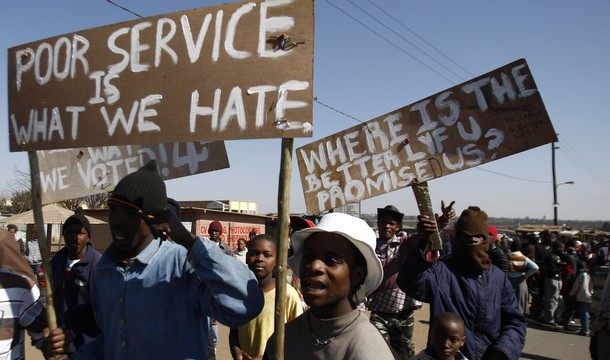
World cup season is upon us again bigger and louder than ever before. Most of the world has been wrapped up in football fever each fan transforming into the hopeful optimist, devoutly believing their team could go all the way regardless of the obstacles. As hosts of the world cup, South Africa has been galvanised in the football atmosphere, in which locals are part and parcel of the party atmosphere. Images of the jubilant colourful South Africans are normally shown as part of sport news, however there appears to be a worrying side to life in South Africa.
As part of the football footage news teams have delved into the reality of life for the majority of poor South Africans. As well as extreme poverty leaving 50% under the poverty line, where a quarter are unemployed, other major problems such as crime, drugs, corruption and HIV are a daily norm for the local people. For those who can afford to, gated residences with private security forces are musts for those who seek to protect their families, but for those who live in shanties or run down suburbs they are left vulnerable. Drugs such as ‘tik' or crystal methamphetamine have had a devastating effect where rape, murder, armed robbery and car-jacking have grown with the soaring addiction rate. Ellen Pakkies, mother of a tik-addict son who turned psychotic and attacked her with scissors, a breadknife and an axe - before she took a rope and strangled him, the problem of inescapable depravation faced by families like the Pakks, leads to a vicious cycle drawing others into this loop of hopelessness and drug addiction.
Most believe the world cup will do little for their situation even though the world cup is hailed as an investment, creating jobs and aiding economic growth in the long term. The world cup is thought to have cost $3.9 billion, spent on stadiums, transport and other necessary aspects of football infrastructure. However for many living in shanties the natural question is why there seems to be billions available for sport but none for providing simple basic needs for the struggling poor.
The world cup appears to be not the only possibility for progression in South Africa. Currently South Africa has well-developed financial, legal, communications, energy and transport sectors and a stock exchange which ranks in the top twenty in the world. In terms of resources South Africa has a large agricultural sector and is a net exporter of farming products. Additionally South African land is rich in coal, diamonds, gold, iron, platinum, copper, uranium, silver and titanium. Therefore not only does South Africa already house an infrastructure capable of larger growth but it also has the resources to drive the progression, which begs the question as to why are so many impoverished?
The reasons for this sad state of affairs have been put down to many issues the two biggest factors being racism and corrupt and incompetent governing - all legacies of colonialism. Like many other developing countries South Africa suffers from a government which is riddled corruption and bungled attempts at sorting its countries problems out. Despite the government's attempts, the distribution of wealth is failing to go where it's needed. Even though some blacks have risen into the wealthier middle class, the majority of blacks are still amongst the poorest alongside an increasing poor white.
Racism in South Africa has a long history stemming from its first interactions with Europeans back in 1487, where Portuguese explorer Bartolomeu Dias, looking for new lands and new countries to plunder first reached Africa's southern tip. It wasn't until the 19th- century that diamonds and gold were discovered sparking the conflict known as the Anglo-Boer war, where the British fought the Boers for mineral wealth. During the Dutch and British colonial years the idea of racial segregation was introduced, as time passed increasing laws or acts were created to subjugate the black South Africans, including restricting ownership of land to 7% of the country. Segregation reached its most grave when the infamous ‘apartheid' was formally introduced into the entire system separating races into white, coloured and black. This segregation also represented a division in wealth where the whites enjoyed the highest standard of living which has continued to recent years. Where there is a clear divide still existent between the wealthier white and poorer black even though there may have been some changes.
Today's problems are part of the legacy left by its European imperialists, a society divided along racial lines post apartheid and a government that cares more about power than struggling to rid itself of corruption. What South Africa needs is a vision provided by a solid basis or reference point. A clear reference point would provide a system which would eradicate corruption, providing laws and a societal ethic which would banish and produce hate for such actions. Also the system would obliterate racism as not only being a backward shallow idea but also binding people on the values of the system not race, cast or nationality.
Islam has given the world such a clear vision, where the people are bound by the values of Islam. This produced a system which saw the Muslim citizen as equal to the Non-muslim citizen in providing for both of their daily needs, not aiming to take from the people only as the imperialist nations have done and still do. This gave rise to a socially and economically strong society. This vision has been cemented in Islamic history.
Uthman رضي الله عنه wrote to his governors:
"Allah has commanded rulers to be shepherds; He did not command them to be money collectors. The attitude of the earliest leaders of this ummah was that of shepherds, not money-collectors. Soon you will find your leaders becoming money-collectors, not shepherds. Once that happens, there will be no more modesty, trustworthiness or honesty. The best way of running the people's affairs is to examine the Muslim situation, find out what their dues are and give them to them, and take from them what is due from them. Then go to ahl al-dhimmah (non muslim citizens) and give them what is due to them and take what from them what is due from them. Then confront the enemy and seek to defeat them by means of sincerity."
Uthman رضي الله عنه wrote to the people in the regions:
"Enjoin what is good and forbid what is evil. No believer should subject himself to humiliation, for I will be with the weak against the strong so long as he has been wronged, inshaAllah."

Zeital
said:
|
Brazil is certainly going to be influential over the next decade. As the southern hemisphere seeks to redress problems from economic inequalities and recover from exploitation, the newly industrialising states will attempt to reform terms of trade. During the 1950’s – 1960’s the ‘southern cone’ in Latin America comprising of Chile and Argentina were making rapid progress and experiencing economic growth. The governments were socialist (although never part of the Soviet led communist bloc). The U.S.A sought to apply its infamous ‘shock therapy’ on these countries (as they already did in Indonesia) and support some very brutal military dictatorships. These military juntas used torture and fear to push through unpopular policies such as privatising national assets and selling them to corporations. The U.S.A made much profit from people’s misery in Latin America. The shameful American role in Nicaragua, Panama, Cuba, Bolivia, Chile, Argentina, Columbia, and Indonesia has been exposed by writers such as Noam Chomsky, Naomi Klein and John Pilger. Brazil is the world’s tenth largest economy and seems to be reaching consensus with other nations in Africa and Asia whilst the economic influence shifts from the northern to southern hemisphere and Far East. Since independence from Portugal, Brazil (along with Latin America) traded mainly with Britain. When U.S dominance became increasingly apparent after 1900 then Latin America turned to Americans as their main trade partners. Since the Monroe Doctrine, American Presidents warned Europeans about interfering within the affairs of the Western Hemisphere. Post World War Two, Brazil became America’s main ally in South America. Alongside newly emerging economies such as India, China, and a recovering Russia, Brazil has assumed greater importance. Most recently this has been seen by attempting to mediate over disputes over Iranian attempts of nuclear enrichment for fuel. On the side of technical achievements, Brazil managed to pioneer early attempts of flight during the turn of the nineteenth century. Alberto Santos Dumont was a pioneer of aviation who flew early ‘airships’ (or dirigibles at the time), and made a public flight of an airplane. The 14-bis was an unwieldy flying machine, yet is flew as a heavier than air aircraft with unaided takeoff on 23rd October 1906. In more modern times Brazil has established its own Aerospace Industry and its own Aircraft Industry: Embraer. The Brazilians even developed a space programme; Brazilian Space Agency, which seeks partnerships with Russia and China. Taiwan, India, and South Korea have also already established their space programmes. In light of these developments it is worth noting how recently industrialising countries have managed to become international players in areas of space exploration and becoming more assertive as the global shift goes towards Far East Asia. Meanwhile the Muslim regions (mostly within the southern hemisphere) are towing behind the established and emerging economies. |
|
|
report abuse
vote down
vote up
|
Zeital
said:
|
Brazil is certainly going to be influential over the next decade. As the southern hemisphere seeks to redress problems from economic inequalities and recover from exploitation, the newly industrialising states will attempt to reform terms of trade. During the 1950’s – 1960’s the ‘southern cone’ in Latin America comprising of Chile and Argentina were making rapid progress and experiencing economic growth. The governments were socialist (although never part of the Soviet led communist bloc). The U.S.A sought to apply its infamous ‘shock therapy’ on these countries (as they already did in Indonesia) and support some very brutal military dictatorships. These military juntas used torture and fear to push through unpopular policies such as privatising national assets and selling them to corporations. The U.S.A made much profit from people’s misery in Latin America. The shameful American role in Nicaragua, Panama, Cuba, Bolivia, Chile, Argentina, Columbia, and Indonesia has been exposed by writers such as Noam Chomsky, Naomi Klein and John Pilger. Brazil is the world’s tenth largest economy and seems to be reaching consensus with other nations in Africa and Asia whilst the economic influence shifts from the northern to southern hemisphere and Far East. Since independence from Portugal, Brazil (along with Latin America) traded mainly with Britain. When U.S dominance became increasingly apparent after 1900 then Latin America turned to Americans as their main trade partners. Since the Monroe Doctrine, American Presidents warned Europeans about interfering within the affairs of the Western Hemisphere. Post World War Two, Brazil became America’s main ally in South America. Alongside newly emerging economies such as India, China, and a recovering Russia, Brazil has assumed greater importance. Most recently this has been seen by attempting to mediate over disputes over Iranian attempts of nuclear enrichment for fuel. On the side of technical achievements, Brazil managed to pioneer early attempts of flight during the turn of the nineteenth century. Alberto Santos Dumont was a pioneer of aviation who flew early ‘airships’ (or dirigibles at the time), and made a public flight of an airplane. The 14-bis was an unwieldy flying machine, yet is flew as a heavier than air aircraft with unaided takeoff on 23rd October 1906. In more modern times Brazil has established its own Aerospace Industry and its own Aircraft Industry: Embraer. The Brazilians even developed a space programme; Brazilian Space Agency, which seeks partnerships with Russia and China. Taiwan, India, and South Korea have also already established their space programmes. In light of these developments it is worth noting how recently industrialising countries have managed to become international players in areas of space exploration and becoming more assertive as the global shift goes towards Far East Asia. Meanwhile the Muslim regions (mostly within the southern hemisphere) are towing behind the established and emerging economies. |
|
|
report abuse
vote down
vote up
|
abu husna
said:
| Brazilians also have achieved nothing despite being the world'soccer giants .While their governement spends a lot of funds on luxuries such as sports facilities ,many have no shelter,they are leaving in shanties.Only khilafah state will provide basic needs for all. | |
|
report abuse
vote down
vote up
|
talha
said:
|
football !!!!!!!!!!!!!!!!!!!!!!!!!!!!!!!!!!!!!!!!!!!!!!!!!! play will be start after establisment of khilafah with kuffar. insaallah we are ready for play. |
|
|
report abuse
vote down
vote up
|
khaled
said:
|
Alhumdulillah! Islam will once again give its solution and all the people of the earth will benefit from the shade of Islam. kaushik |
|
|
report abuse
vote down
vote up
|
| < Prev | Next > |
|---|


