
Khilafah.com

Thursday
Feb 09th
Text size
  • Increase font size
  • Default font size
  • Decrease font size

Understanding the current anti-government protests in Iran

E-mail Print PDF

RELATED ARTICLE - Q&A: The Iranian Election Crisis

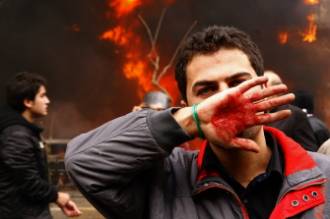
The Western media has once again gone into overdrive as mass protests have hit the streets of Tehran. On the day of Ashura mass protests took place across Iran's main cities and images of baton wielding security officers were broadcast across Western news channels. On the day of Ashura as many as 15 people were killed in the clashes during the protests. The demonstrations although small in number have been the continuing result of what followed the June 12th 2009 presidential elections. The defeated reformist candidates claim the entire election was against the sentiments of Iranians, the majority of whom opposed incumbent Iranian President Mahmoud Ahmadinejad and his policies but whose will was thwarted by a falsification of the electoral results by an unpopular and dictatorial ruler who made it appear that he had won the election massively rather than lost it. The Western media has continued to beam this narrative around the world and argue that the demonstrations represent the will of the Iranian people for Freedom and Democracy.

Western-Iranian relations

The Western coverage of the elections is rooted in the old axis of standing against the Islamic revolution and supporting the reformists who want a free and liberal Iran. The West has engaged with Iran on this basis for decades and continues to do so. The myth the Western world has duped themselves into believing is that the fall of the shah was due to a mass movement of people demanding liberalisation. If such a group of reformists are supported by the West they would become the majority and rule the country. Western reporters believe that anyone who knows who Beyonce is, owns an iPod, has a blog and knows what it means to Twitter must be an enthusiastic supporter of Freedom and Democracy. Such individuals can be found among the professional classes in Tehran, as well as among students. Many speak English, making them accessible to Western journalists, diplomats and intelligence services. They are the ones who can speak to Westerners, and it is from such people Westerners receive the information that a revolution is on hand.

This is why it is important to bear in mind that almost all reports coming out of Iran on the demonstrations are originating from opposition Web sites, which are inclined to make the crisis appear as intense as possible and to maximize the apparent strength of the protesters. Many of these sites are based outside of Iran and depend on the same intermittent communication with Iran as others do.

Western interference in Iran is not new. The West has constantly interfered in Iran's domestic affairs throughout recent history. In 1953 the US Central Intelligence Agency (CIA) overthrew the elected government of Mohammed Mosaddeq at the request of, and with support from the British government due to the nationalisation of Iran's Oil wealth in what the CIA called Operation Ajax. This brought to power the pro-Western Mohammad Reza Pahlavi who became the lynchpin for protecting Western interests in the region until he was overthrown in the Islamic revolution in 1979. US financial support is in fact aimed at regime change and goes beyond the allocated $75 million. In May 2007, ABC News reported that President Bush had authorised a covert CIA program against the Iranian regime. In addition to public and covert funding of Iranian opposition groups, the United States also supports individual dissidents through various means.

Failed State

The current unrest has its origins in the elections. However what we are witnessing is a backlash as both the conservatives and reformists have been unable to solve many of Iran's problems especially its economic issues. 3 million people are unemployed in Iran and the trend is set to continue.

Currently less than 30% of the Iranian population witnessed the Islamic revolution, as 70% of Iran was born after 1979. Those born after 1979 view the economic problems as a result of the failed policies of the Islamic revolution. As the conservatives dominate the key ministries some have taken the slogan of reform, established political parties on this basis and taken to the streets.

The fundamental problem with Iran is the fact that the people of Iran have been failed by successive governments. Mohammad Reza Pahlavi focused on modernising Iran in the name of advancement. This modernisation was in many areas and included social reforms. However nothing materialised. The construction of a few factories did nothing to halt poverty and poverty increased even though more and more oilfields were discovered in the Persian Gulf. The Shah wanted to break the existing economic structure which was built upon farming and made the clergy immensely wealthy. During the 1960's the Shah concentrated on his Social reforms. His reforms were built upon the emulation of the West and instituted western dress, symbolised by his wife and daughters. Such behaviour only alienated the mostly Muslim population from the ruler and this led the Shah to resort to brute force. As the 1970's were in full flow many viewed the Shah as a despot, and the economy had not modernised as he promised. As the Shah became ever more authoritarian many began to demonstrate in what they saw as injustices perpetuated by the Shah. The Shah's failure to solve the problems of the country resulted in many to look for alternatives.

Ayatollah Rahulla Khomeini came to symbolize ‘change' and many groups that were not even Islamic mobilised with other groups and brought the country to a stand still. When the Shah ordered the army to open fire on the demonstrators - that was the final straw. Before anyone could shout revolution the Shah had fled the country.

As soon as the Islamic revolution was in full swing cracks began to appear with the groups that brought Khomeini to power. What had began as an authentic and anti-dictatorial popular revolution based on a broad coalition of all anti-Shah forces, it soon transformed into a power grab. Except for some of Khomeini's core supporters, the members of the coalition thought Khomeini intended to be more a spiritual guide than a ruler. However his core supporters took positions in important offices whilst many of those who had sacrificed to bring Khomeini to power found they were either exiled, imprisoned or sidelined.

The 8 year war with Iraq resulted in the nation's production being geared towards the war effort. The economic concerns of the people were completely neglected. Islam was nowhere to be seen. Islam was never applied, however Khomeini did everything but refer to the Qur'an or the Sunnah. Khomeini had been in exile for over 10 years and had no ruling or leadership experience, however he held his grip on the nation through hook and crook - in reality Khomeini turned out to be no different to the Shah.

Like the Shah Khomeini did nothing to address the economic problems of the nation. The 1997 landslide victory of Mohammed Khatami, brought the reformists to power. Many students viewed reform as the way forward. Khatami openly campaigned for engagement with the West and Western values in the shape of freedom and democracy. The reformists have attempted to end the animosity with the US but decades of mistrust between Iran and the US remains. Reformists attempts at moving closer to the US was undermined when Bush made his state of union address and included Iran in his axis of evil speech. Many Iranian seeing this brought Ahmadinejad to power, a staunch conservative.

The Iran economy has long relied on its energy sectors. Iran has the world's largest gas field, the world's largest gas reserves after Russia and the world's largest oil reserves after Saudi Arabia. However Iran's 1940's constructed energy infrastructure is crumbling and inflation and unemployment is rampant and out of control. Ahmadinejad came to power on back of many economic promises that have not materialised. Today's Iran suffers from a major prostitution problem. According to many surveys up to 500 000 women under the age of 30 make up Iran's prostitution problem. Many have been forced into this due to poverty and the stigma of divorce. A number of such girls are also runaways who were forced into temporary marriages. Iran also has a huge drug problem. According to the Iranian government there are over 1.2 million drug addicts, with HIV on the rise. Alcohol is widely available and if one is not a cocaine addict they are most likely addicted to Alcohol.

The demonstrations that have filled the news stories of the West represent those who want change due to Ahmadinejad's economic failures. He has reneged on all his economic promises and created an economic bomb that will go off at any time. Ahmadinejad's 12th June 2009 election victory is seen by many in Iran as a continuation of such failed policies. Ahmadinejad has done nothing for the 3 million unemployed. While the catalyst for these demonstrations was an election, the election issues were the economy and unemployment. The Western media continues to propagate that the demonstrators represent Iranian public sentiment, but they fail to see the economic legacy that haunts the people of Iran.

Conclusion

Mahmoud Ahmadinejad symbolises the failure of the conservatives who have unable to revive the economy. Iranian society is polarised, the educated middle classes adore the West whilst the poor although Islamic are unable to understand how the Islamic texts deal with modern problems. This confusion is leading many to conclude Islam has been the problem. Whilst the Reformists call for the developing of relations with the West, the Conservatives on the surface have remained anti-Western which resonates with large sections of the Iranian public. However behind the scenes the conservatives view the US very differently and have worked hand in hand with the US and protected their interests in the region. Tehran continues to extend support to the Islamic Supreme Council of Iraq (ISCI), a party Tehran created in 1988 to maintain Iran's influence in Iraq's Shi'ah South. The ISCI gathered many of the groups in the South together in order to partake in America's political settlement for the nation. In Afghanistan, Iran runs extensive reconstruction and training programs in Kabul, Herat and Kandahar. Thus far, Iran has successfully prevented American embarrassment in both countries.

The Conservatives in Iran have like many leaders across the Islamic world used Islam for their own ends. They have failed the Ummah and have used the sincere Islamic sentiments of the Ummah to keep themselves in power whilst the Ummah languishes in poverty. Such insincere leaders will meet Allah سبحانه وتعالى and will receive what they deserve. The people of Iran like the wider Ummah want change, however the imitation of the West has a track record of failure. Only through unification of the Muslim lands can the Ummah take her destiny into her own hands.

Trackback(0)
Comments (8)add comment

Zeital said:

Unstable Financial Institutions and the foreshadowing collapse of the U.S Dollar have brutally exposed the limits of America’s economic hegemony. Post World War Two, following the Bretton Woods System the U.S Dollar was the Reserve Currency. The pitiful post war condition of Europe, Asia and the U.S.S.R, left the U.S.A with immense bargaining capability. America was the globes industrial powerhouse, which was the only state to emerge stronger after World War Two. However, the savage war of attrition in South East Asia, mainly Indo-China began to drain the U.S economy and undermine its very society.

This was keen keenly observed by prominent activists:

“One of the greatest casualties of the war in Vietnam is the Great Society ... shot down on the battlefield of Vietnam” Reverend Dr Martin Luther King Jr

Campaigners for Social Justice recognised that the U.S.A was attempting to supplant French, Dutch, and British colonialism in South East Asia with U.S Corporatism backed by Right Wing Military Juntas. The American direct involvement became more visible in the Muslim world since 1970, with agitation against Libya and the Revolution of 1979. Although grievances dated back to American support for Israel and repressive regimes such as that of Egypt, events after 1979 set an increasing tone of belligerency between American and the Muslim world. This paralleled the Anglo-American led attempt to undermine the U.S.S.R, led by an increasingly bellicose President Reagan, (with the fateful involvement in Afghanistan and the Iran-Iraq war as a portent of things to come).

The U.S.A is printing worthless dollars and its only recourse is to seize control over resources. As the dominant military-industrial power (clearly enjoying supremacy in power projection over all other would be rivals), this remains America’s remaining card. China is still building up a Blue Water Navy, and in need for Energy Security. China would be vulnerable in defending its supply routes across the Indian Ocean. In addition China has significant investments in developing Persian infrastructure, so instability in Central Asia/Near East could threaten Chinese industrial/economic expansion. Notwithstanding China also is in desperate search to replace increasingly worthless Dollar reserves with Gold Bullion or other stable sources of real wealth. American policy makers can see Russia, India, and particularly China’s weaknesses and interdependence. Neither the U.S.A nor China (an autocratic run sweatshop for American mass consumerism) can dictate terms; but the U.S.A has a material/military advantage in the Pacific and Indian Ocean. However, as America’s economic heart undergoes a collapse, the industrial military might is unsustainable. Anglo-American led N.A.TO or local allies are losing soldiers, agents, and material to a never ending but ever expanding war.

Britain forever sees American sucked into a quagmire with no hope of extraction, bleeding from a thousand cuts. Hence, with help from a new found ally; France (really a long time ally and staunch rival), the old imperial states seek to reassert influence overseas. Mesopotamia, Persia, Lebanon, Syria, and Sudan are regions Europe and Britain would like to gain a foothold, partly under American military assistance to provide heavy ‘firepower’.

ARTICLE: IRAN: Heading for more violence? by Jean-Pierre Perrin
http://www.truthout.org/1231093

LINKS:

http://maxkeiser.com/

http://www.ravibatra.com/
 
report abuse
vote down
vote up
December 31, 2009
Votes: +0

Adnan Khan said:

Salaams

Europe through Britain and France tried everything they could to influence the post-election protests through their agents in order agitate the situation in Iran. It was indeed a very weak attempt to bring down the Ahmadinejad regime and replace it with their agents. This was the same as the Reformists candidates who were attempting through there demonstrations to bring down the regime.

The US position is summed best by Obama’s statement at the time that there were no big differences between Ahmadinejad and Mousavi except in some minor or inconsequential detail. The US did not use the protests to bring down the regime, fundamentally because as Ahmadinejad had stated in his interview with New York Times during his visit to New York for the UN conference in September 2008 "Iran has extended its hand of cooperation to the United States on the issue of Afghanistan...and our country had given assistance to the US in restoring peace and stability in Iraq." i.e. the current conservative regime has protected US interests in the region. Europe’s feeble attempt to change this status quo by bringing its agents to power, resulted in the US in effect supporting Ahmadinejad’s regime by remaining largely silent on the issue.

The US has many links with the reformists (there will be an article on this soon), Rafsanjani has links with the US that go back two decades. However the Conservatives pragmatism, achieves US aims in the region. The decision taken by the Ahmadinejad regime to work with the US in bringing a settlement to Iraq – The US cannot win the Iraq war without Iran’s help. Iran has deep links with various movements in the South of Iraq. Iran ordered its largest proxy the ISCI to enter the political process, which brought the insurgency in the South to an end. Iran similarly is working with the US in Afghanistan through many reconstruction projects and has in fact brought stability to the part of Afghanistan that shares a border with Iran. Such decisions are not the decisions of Ahmadinejad alone, it would have been taken at the highest level. This shows the conservatives are not only the agents of America, they have protected US interest in the region.

Historically the US stood against the Conservatives and supported reformists’ calls, today the US has agents in both camps. In the election aftermath it appears the US stood on the side of the conservatives as Europe attempted to make the demonstrations more than they were, what this really meant was Europe was attempting to remove US influence and replace it with theirs, which in turn will impact the US in Iraq and Afghanistan, giving Europe substantial leverage over the US – Ultimately attempt failed.

The US is using both camps for their aims and Europe is attempting to challenge the US. As regarding Mottaki’s statement, there are some imams who are not agents of the West and make statements independent to the regime.
 
report abuse
vote down
vote up
December 31, 2009
Votes: +1

Abdullah said:

Selam aleykum,

didin't hizb say in its analysis of the election aftermath that the opposition is working with Britain und that the US is supporting or at least not working against the current regime? Why is it that this analysis is saying the opposite i.e. that the reformists work with the US? That doesn't make any sense to me especially if you say that the US is working with both the refomrists and the conservatives. And if Britian is not the driving force behind the unrest(as stated in the official analysis) why is Mottaki saying things like "...Britian will get a slap in its mouth..." etc.
Please clarify the issue brother...
jazakallahu khayran
 
report abuse
vote down
vote up
December 31, 2009
Votes: +0

Adnan Khan said:

Britain competes with the US around the world, due to the gap between the US and the rest of the world, which although is closing, Britain generally has reduced itself to complicating, diverting, subverting US plans around the world. This strategy will never stop the US but just delays or hinders US aims – this is really all the UK can do.

The Persian Gulf is probably the most strategic location in the world, Aside from the world’s largest oil field it is also home to the world’s largest gas field. In Iran generally the UK has lost its influence, remember Britain took part in bringing the Shah to power in 1953. Today both the Conservatives camp and reformists work behind the scenes with the US.
 
report abuse
vote down
vote up
December 30, 2009
Votes: +1

reader said:

Why is the UK more vociferous than the US? IS there a conflict of interests between the twio?
 
report abuse
vote down
vote up
December 30, 2009
Votes: +0

Adnan Khan said:

Ali Akbar Rafsanjani appears to be the leader of his reformist allies (former President Mohammed Khatami, former Prime Minister Mir Hossein Mousavi and former Parliament Speaker Mehdi Karroubi), they have been losing ground to the Ahmadinejad camp, and their businesses have been suffering.

Rafsanjani has been using his vast network outside the country to counter the growing power of Ahmadinejad at home. Because of the 30-year-old sanctions, the regime has had to develop international partners to engage in trade overseas. All those contacts were developed by Rafsanjani and he continues to control them. Ahmadinejad, since he has come to power, has tried to develop his own contacts for doing business with the outside world. Rafsanjani, through his associates outside the country, has provided the information on the people and groups that Ahmadinejad has been working with to US and British intelligence in order to block outside deals.

Rafsanjani has established links with the US, the Iran-Contra affair brought this to the fore. The reformists have always received outside help, Rafsanjani is an American stooge, corrupt as anything. The reformists are pro-Western, they want to end the sanctions and develop relations with the West, as the US developed the sanctions, and is the superpower, many of the behind the scenes deals with regards to Iraq and Afghanistan have been with the US. I would say the US is providing support to the reformists, but this doesn’t mean it will always remain so. There will inshallah be an article on ‘US interference in Iran’ uploaded soon
 
report abuse
vote down
vote up
December 30, 2009
Votes: +1

Abdul Mohti said:

salam alaikum brothers and sisters. i would like ti know, ho is backing moussavi up in iran...?
is the opposition pro-british? l
 
report abuse
vote down
vote up
December 29, 2009
Votes: +1

Adnan Khan said:

To a large extent there is a battle taking place between rival economic elites, the old one led by Ali Akbar Hashemi Rafsanjani, and the emerging one led by President Mahmoud Ahmadinejad. Rafsanjani has developed a vast empire due to his position in the regime whth his closest allies receiving many kick backs. Such corruption is being challenged by Ahmadinejad, thus threatening Rafsanjani and the reformists. Many of the old elites are attempting to retain the special privileges they have enjoyed for years.
 
report abuse
vote down
vote up
December 29, 2009
Votes: +2

Write comment
quote
bold
italicize
underline
strike
url
image
quote
quote
smaller | bigger

security image
Write the displayed characters


busy