
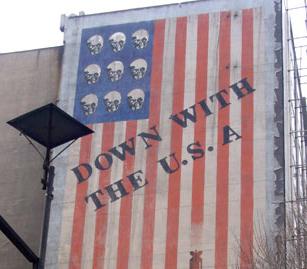
 On 13/12/2008, Robert Gates, the US Secretary of Defence speaking at international security conference in Bahrain gave some insight about forthcoming relations between America and Iran. He said, “Nobody is after a regime change in Iran…What we are after is a change in policies and a change in behaviour so that Iran becomes a good neighbour of people in the region (rather) than a source of instability and violence.”
More or less, throughout his election campaign Barrack Obama has stressed the importance of talking to Iran and has played down the prospect of employing military action. Writing in Foreign Affairs in July 2007, Obama stated: ‘Throughout the Middle East, we must harness American power to reinvigorate American diplomacy. Tough-minded diplomacy, backed by the whole range of instruments of American power-political, economic, and military-could bring success even when dealing with long-standing adversaries such as Iran and Syria’.[3] In a September 2007 in a speech in Iowa, Obama voiced concern over Bush’s policy on Iran. He said, “…we hear eerie echoes of the run-up to the war in Iraq in the way that the President and Vice President talk about Iran. … They issue veiled threats. They suggest that the time for diplomacy and pressure is running out when we haven’t even tried direct diplomacy. Well George Bush and Dick Cheney must hear – loud and clear – from the American people and the Congress: you don’t have our support, and you don’t have our authorization for another war.” In December 2008, Obama gave an interview on Sunday’s “Meet the Press” with host Tom Brokaw. During the interview Obama said that he would pursue “tough but direct diplomacy with Iran.” Obama said that he would offer Iran economic incentives if it abandoned its nuclear program but would seek to punish the country with tougher sanctions if it refused to cooperate.
Brzezinski has been an avid supporter of normalizing relations with Iran. Brzezinski, in his book ‘Second Chance’ chastises the Bush administration for damaging American prospects in the Middle East through the futile pursuit of regime change. In December 2008, The Salt Lake Tribune quoted Brzezinski as saying, “One of the reasons that I do favour a dialogue with the Iranians, and if it is feasible, the establishment of normal diplomatic relationships, is that I think that would help promote political change in a country which is far less centrally controlled, far less subject to effective state authority than was or is the case in the People’s Republic of China.” It might be added here that whilst Hilary Clinton has adopted a hardened posture against Iran during her presidential campaign, it is expected that she will reflect the new approach both in word and deed.
3. Apart from the clandestine cooperation between the two countries to secure American interest in the region-ranging from supporting Hamas and Hezbollah in the Levant, strengthening the Iraqi government and fighting Sunni and Shia resistance fighters, to stabilising Afghanistan-official contact has gradually grown over the past year or so. The Bush administration has progressively taken a number of steps to prepare the ground for Obama to complete the normalisation process. For instance the presence of the highest ranking US official, William Burns in the Geneva talks with Iran came after a series of meetings between the two countries. Another is the administration’s announcement to establish a U.S. diplomatic mission in Tehran to facilitate people to people contact. America has also snubbed Israeli advances to attack Iran. America played down Israel’s show of air power over the Mediterranean a few months ago, and has refused to sell the powerful GBU-29 bunker-busters bombs.
More recently, the US has exploited Israeli apprehensions over Iran’s nuclear programme and offered Tel Aviv new security guarantees. This includes NATO protection and a promise of a nuclear umbrella. On 2/12/2008 NATO authorized a pact to strengthen and expand Israel’s security and political relations with the states in the military alliance. Under Individual Cooperation Program (ICP) agreement permits the exchange of intelligence information and security expertise on different subjects, an increase in the number of joint Israel-NATO military exercises and further cooperation in the fight against nuclear proliferation. It also paves the way for an improvement of collaboration in the fields of rearmament and logistics and Israel’s electronic link to the NATO system. Livni hailed the treaty and said,“Israel’s security capabilities are a household name and we see the strengthening of cooperation between Israel and the international security body as a strategic objective that reinforces Israel.”[4]
According to press reports, the U.S. nuclear guarantee would be backed by a new Israeli missile defence system, and the U.S. early-warning radar system already deployed in the Negev desert to counter Iranian missiles. The report further suggests that by granting Israel a nuclear guarantee the U.S. is willing to come to terms with a nuclear Iran, where the uranium enrichment program has reportedly “passed beyond the point of no return.” [5] No doubt America will use NATO in the future to push for a resolution to the Palestinian question, check Israeli ambitions of expansion beyond Palestine and deploy NATO forces to quell popular uprisings in the region. On 12/12/2008 Brzezinski alluded to some of the US motives behind NATO’s agreement with Israel. He said, “The possible involvement of NATO is not a question of war on terror, but ensuring that the Palestinian state is not a military threat, but at the same time stable and secure, and NATO presence could bring this double benefit. Perhaps a NATO presence [could] ensure a peace agreement, or maybe even an American presence along the Jordan River, to give the Israelis sense of geographical security.”
4. Despite the continuous imposition of sanctions against Iran over its nuclear programme, the West is nowhere close to halting its enrichment programme. This is because America has deftly exploited the five year old negotiations between the EU-3 and Iran to coax the Europeans into a protracted discussion over Iran’s nuclear ambitions. Furthermore, America has added fuel to the fire through the bravado of the neoconservatives and doggedness of Ahmadinejad, which has resulted in an atmosphere of war and created perpetual tensions in the region. By doing so, America has gained a strategic advantage by persuading the Gulf Arab countries to acquire nuclear energy, by nudging the Israelis into a security pact and by permitting Iran to divert its civilian programme to build atom bombs. On 12/12/2008 the US State Department announced that United States was close to concluding a nuclear cooperation agreement with the United Arab Emirates. The so-called 1-2-3 agreement would be similar to the nuclear cooperation accord the United States reached with India in 2005. It would allow the United States to sell nuclear fuel, equipment and technology to the UAE. Similar agreements are being pursued with Bahrain and Saudi Arabia. [6] In summary, America is working towards the nuclearization of the Middle East.
5. Some Israeli officials have started to prepare the Israeli people for a change in American policy towards Iran. On 18/11/2008 Israel’s military intelligence chief said he saw a positive side to a possible US dialogue with Iran. Major-General Amos Yadlin said, “Dialogue with Iran while at the same time insisting on clear and defined parameters for stopping the Iranian nuclear programme is not necessarily negative.” [7] On 9/12/2008 the Arab News reported that Israeli President Shimon Peres said that the union of western countries against Iran’s policies and the drop in oil prices has rendered the military option against the Islamic Republic unnecessary at this point. Yet there are still some pro-Jewish supporters in the US who pushing Bush administration to attack Iran. In response to their endeavours Brzezinski has warned: “Israel will do harm to its relations with the United States if it insists on lobbying Washington for an American military strike on Iran. It wouldn’t be particularly good for American-Israeli relations, and there will be a lot of resentment against [Israel].”
In conclusion, America under the Obama administration will press ahead with normalising US relations with Iran in exchange for a security pact with Israel. However, the pace of the normalisation process will be slow and will probably gather pace after the Iranian presidential election in 2009 and with the removal Ahmadinejad. America will employ a series of carrots and sticks to mould the Iranian regime to implement its policies and protect US interests.
The introduction of NATO is ominous sign in that America wants to safeguard the hydrocarbons (oil and gas) of the Middle East from Russia and China. Iran will serve as America’s lynchpin in providing energy security and becoming a frontline state against Russia. The spread of nuclear technology in the Middle East under US auspices signals that from a geostrategic perspective, America is looking to completely surround Russia and China with nuclear armed states stretching from the Eastern Europe to the Asian pacific. The intention is to considerable reduce Russian and Chinese nuclear strike capabilities, and limit the theatre of war to these frontline states. Nevertheless, America faces huge challenges and the foremost is to subdue the resurgence of radical Islam accentuated by the Bush years.
The Muslims of the region and beyond have been manipulated before and served as US pawns to bring down the Soviet Union. Today, Obama and some of his advisors believe that this feat can be repeated against Russia and China. The Muslim ummah must learn from its past experience and turn the tables on these major powers by re-establishing the rightly guided Khilafah which will make these powers fight each other and raise high the Islamic banner over their destruction…inshallah.
Abid Mustafa
15/12/2008
References
1 http://www.google.com/hostednews/afp/article/ALeqM5gukPwZ1QPZ-YyzDTyYD370vQaZHA ; title: Gates warns US adversaries not to test Obama;14/12/2008
2 Council of Foreign Affairs Task Force: Iran: Time for a New Approach; Co-Chair Brzezinski and Gates; July 2004
3 Foreign Affairs : Renewing American Leadership; Barack Obama; July/August 2007
4 Haaretz Online: NATO okays pact to boost security, political ties with Israel; Barak Ravid;2/12/2008
5 RIA Novosti Online: U.S. may offer Israel ‘nuclear umbrella’ against Iran – paper U.S. may offer Israel ‘nuclear umbrella’ against Iran – paper 11/12/2008
6 VOA:US Nears Nuclear Accord With Gulf Emirates; By David Gollust The State Department;12/12/2008
7 Dawn online; General at odds with Tel Aviv on US-Iran talks; 18/12/2008